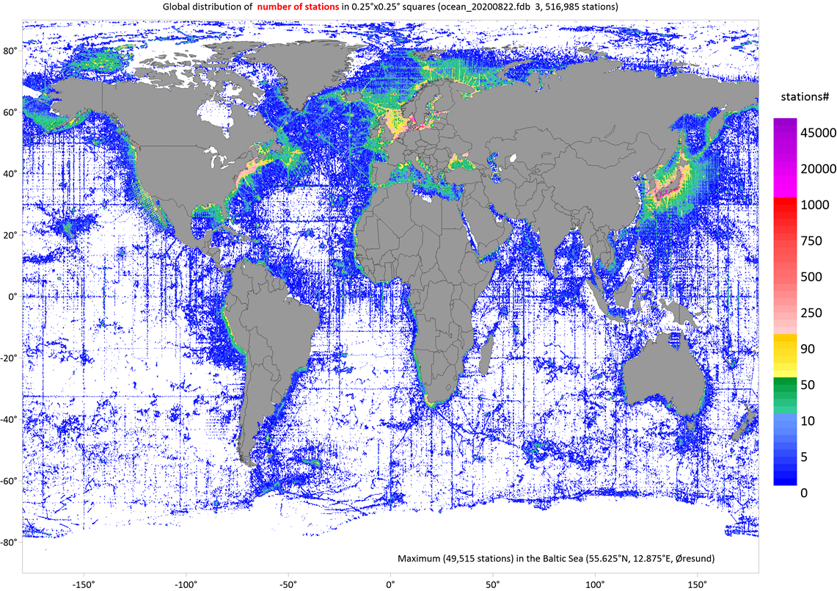
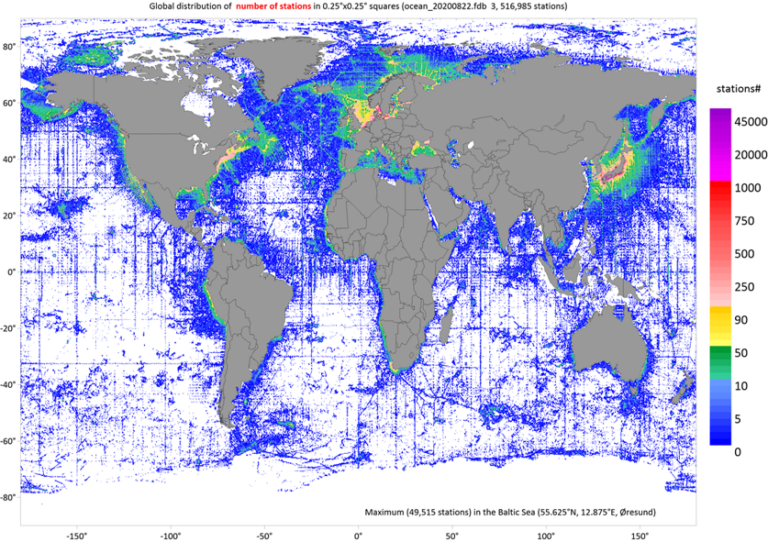
The database’s development sought to quantifying coupled cycles of carbon, oxygen, and nutrients for determining and achieving safe operating spaces with respect to ocean tipping points.
The database compiled 3 707 857 stations collected from 83 568 cruises. The original data sources that were from (1) The Global Ocean Data Analysis Project (GLODAPv2.2019), (2) Ice-Tethered Profiler (ITP), (3) Global Oceanographic Data Archaeology and Rescue Project (GODAR), (4) ARGO biogeochemistry profiling floats (ARGO-BGC), (5) World Ocean Database 2018 (WOD), (6) Ocean Carbon Data System (OCDS), (7) Data Publisher for Earth & Environmental Science (digital data library) (PANGAE), (8) Nansen and Amundsen Basins Observational System (NABOS), (9) Ocean Melting Greenland (OMG), and (10) Nansen Environmental and Remote Sensing Center (NERSC).
The data contains 47 biogeochemistry variables covering the whole world.
Data access: http://dx.doi.org/10.11582/2022.00039
 Adaptation to climate change
 Oceans, seas and waters