
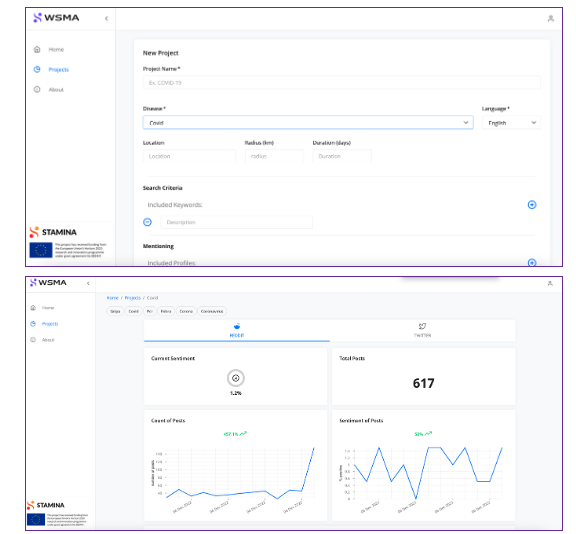
The tool features a dashboard through which end-users can define key phrases, locations, accounts and time frames they are interested in monitoring. Based on these parameters, WSMA crawls posts from social media (currently only Twitter and Reddit are supported) and stores them in secure databases. WSMA processes these data and every hour produces analytics that are displayed on the dashboard. The analytics include: counts of relevant posts over time, trend of the sentiment polarity expressed in the retrieved posts, frequency of the monitored key phrases, counts of co-occurring terms, most popular Reddit posts. Furthermore, two analytics pipelines take place in the backend with the aim of providing inputs to other tools: 1) geocoding of tweets (based on location information provided in the user description field or in the location tag attached to a tweet) which can be sent to other visualisation tools for map-based visualisation of possible origin of tweets of interest 2) detection of anomalies, occurring when the counts of monitored keywords exceed a statistically determined threshold, which can be directly communicated to other emergency detection tools.
Addressing target audiences and expressing needs
- We are sharing our knowledge
- Business plan development
- Advice on exploiting the ITC solution in our existing products
- Guidance on developing the solution to higher TRL
- Others/ No specific audience
- International Organisations (ex. OECD, FAO, UN, etc.)
- Other Actors who can help us fulfil our market potential
R&D, Technology and Innovation aspects
The WSMA tool was entirely developed during the STAMINA project and transitioned from TRL2 to TRL6. Only initial versions (proof-of-concept) of parts of the tool (the Twitter crawlers and the Sentiment Analysis pipeline) had been developed previously by TRI and SQD respectively (TRL2-3). WSMA was tested in two trials, using simulated data. Its functioning with real data has also been successfully proven although more extensive tests are needed to reach a stable implementation. Namely, thanks for end-user engagement activities, we found that we needed to focus more on developing the explainability and transparency aspects of such a tool before developing the technology any further and bring it to market.
While the output TRL level of WSMA is lower than the average STAMINA tool, the underlying components used were, when feasible, were off-the-shelf open-source components with high TRL (TRL 8-9), and widely used in other software tools. While the WSMA has not matured currently enough to compete with available competitive products, the overall development showcases the ability to mine data from multiple social media channels, and to simultaneously monitor multiple projects while assessing both qualitatively and quantitatively numerous social media posts for health and pandemic response purposes. Moreover, WSMA demonstrates the ability of the STAMINA system as a whole to include, communicate and consume data from tools of lower TRL, which is a critical functionality that allows testing new functionalities and prototypes.
The tool is open-source. If a developer or user has access to Twitter and Reddit API they can use the tool to crawl posts and generate analytics.
- Europe