Result description
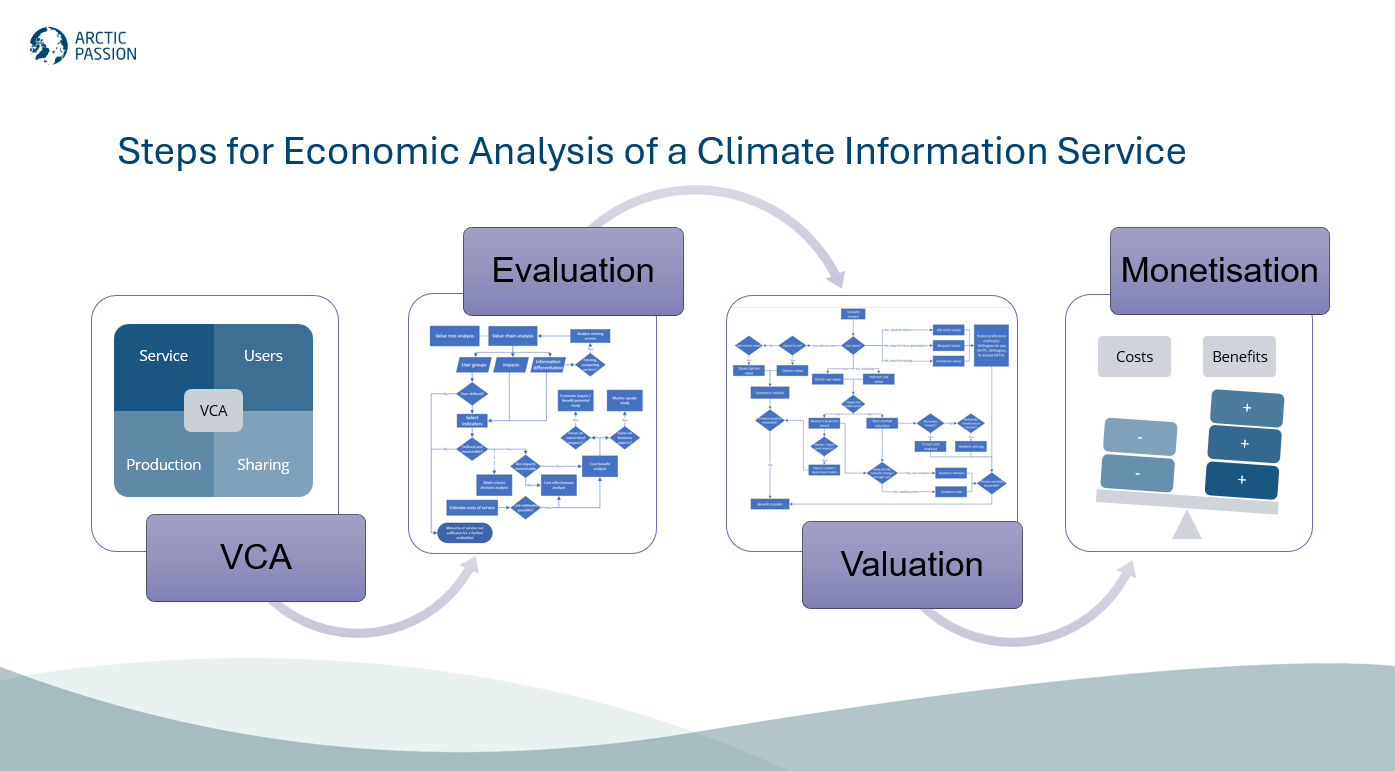
Our results present a practical, easy-to-follow Guidebook for assessing the socioeconomic benefits of service products. Prior to the Guidebook, economic theory is introduced to provide background useful for conducting and interpreting economic evaluations. The Guidebook is structured around an evaluation hierarchy presented as a pyramid. Step 1, Qualitative Assessment, applies value chain analysis (VCA) and may also use value tree analysis (VTA). Web traffic analysis can support VCA and help quantify impacts in later steps where applicable. Step 2, Evaluation, provides a step-by-step approach for selecting an appropriate economic evaluation method and briefly introduces each method. Step 3, Valuation, focuses on quantifying and monetising impacts within the evaluation. For Steps 2 and 3, each method includes information on limitations and suggestions for further reading. Finally, the Guidebook explains factors influencing the selection of an economic evaluation approach for climate information services.
Addressing target audiences and expressing needs
- Grants and Subsidies
- Other blended financing
- Help in technical expertise
Target audience of the guidebook consists of climate information service developers, actors investing in climate information services, and audience interested in understanding how economic approaches can be applied to evaluate climate information services. The guidebook can also be used to support other than economically oriented evaluations by offering complementary information on how impacts of a climate information service can be monetised and assessed, if needed and applicable.
- Public or private funding institutions
- Research and Technology Organisations
- Private Investors