
Result description
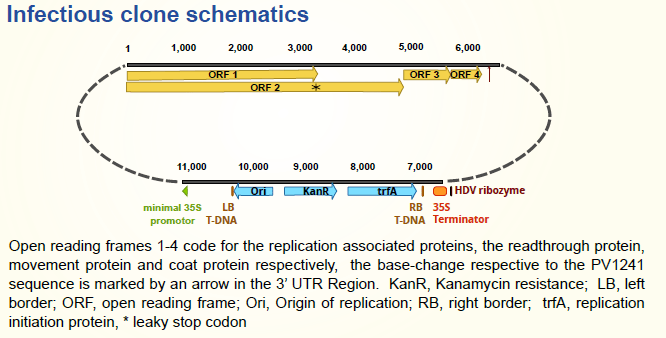
Tomatoes are among the most economically important crops in the EU and worldwide. Emerging viral diseases have a high potential to spread with global trade and have a huge impact on production. ToBRFV was first encountered in 2014 in Israel and described as a new species in 2016. It has a huge economic impact on the tomato production. However, it can also infect other hosts such as Chenopodium species, which are common wild plants in Europe. Since its discovery ToBRFV was found in tomato producing regions in Europe, Africa, Asia, Australia and America. ToBRFV is currently classified in the EU as regulated, non-quarantine pest (RNQP). Infectious clones are important tools for investigating virus-host interactions, for optimizing and standardizing resistance screens, and for identifying symptom determinants that could lead to attenuated viral strains that could be used for cross-protection.
Addressing target audiences and expressing needs
- Collaboration
The scientific importance of the ToBRFV infectious clone is that it serves as an identical starting point for testing plant materials, finding relevant ToBRFV mutations and either screening or keeping viral inoculum. JKI is open to any collaboration for further research on its ToBRFV infectious clone, and can make it available free of charge – after signature of a Material Transfer Agreement – to any interested scientists, seed companies (e.g. for screening or keeping viral inocolum) or other actors.
- Research and Technology Organisations
- Academia/ Universities
R&D, Technology and Innovation aspects
The ToBRFV infectious clone created by JKI can be immediately shared with interested parties, following the signature of a material transfer agreement.
The JKI ToBRFV infectious clone can be replicated by following the methodology outlined in the scientific publication: https://apsjournals.apsnet.org/doi/10.1094/PDIS-08-24-1665-RE