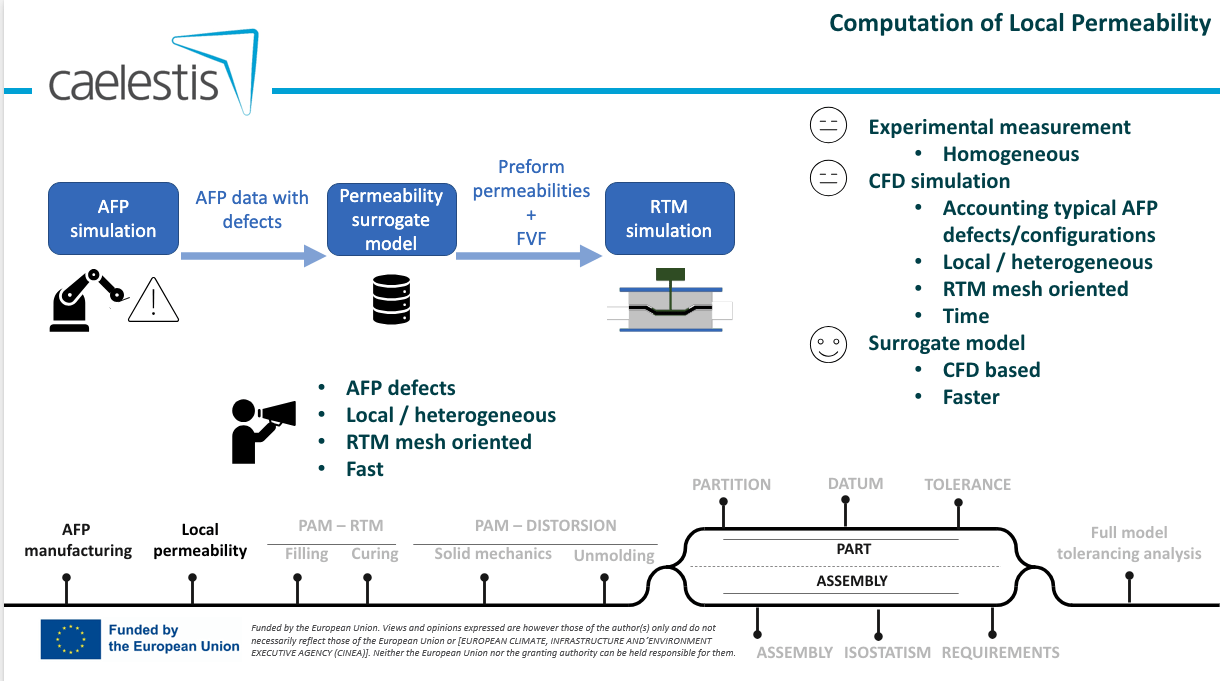
Automated Fiber Placement (AFP) is highly efficient but introduces manufacturing defects (gaps, overlaps) that alter the permeability of composite preforms. Standard simulation tools often assume “perfect” preforms, failing to predict how these upstream defects impact the subsequent Resin Transfer Molding (RTM) injection phase. This leads to unforeseen dry spots, voids, and high scrap rates in complex aerospace parts.
We have developed a novel surrogate model (TRL 4) that bridges the gap between AFP and RTM simulations. By integrating physical simulation data, the model predicts how specific AFP defects influence resin filling behavior and flow fronts. Written in Python, it serves as a “computational bridge,” allowing manufacturers to anticipate and mitigate impregnation issues before physical production begins.
Addressing target audiences and expressing needs
- Business partners – SMEs, Entrepreneurs, Large Corporations
- Help in technical expertise
- Collaboration
We are seeking industrial partners to validate the model on complex geometries (TRL 5-6) and software vendors for integration into existing CAE/manufacturing suites.This could include forming a consortium for HORIZON-CL4-2027-04 (AI-Driven Robotics for Industry) to further develop this model into a real-time control system for robotic manufacturing.
- Other Actors who can help us fulfil our market potential
- Research and Technology Organisations
- Academia/ Universities
R&D, Technology and Innovation aspects
Prototype model developed and validated against physical simulation data. Currently exploring integration into commercial simulation suites and Digital Twin architectures.