
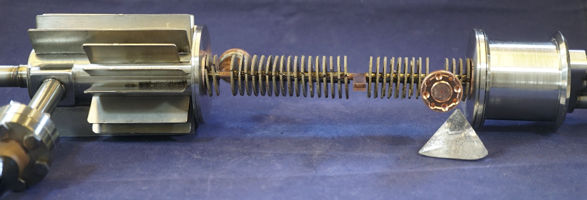
Travelling Wave Tubes (TWTs) are wide band power vacuum electronic amplifiers widely used in microwave communications. A TWT includes an electron gun, a slow wave structure (SWS) usually made of OFHC (Oxygen Free High Conductivity) copper, a collector, a magnetic focusing system and vacuum RF windows to seal the flanges. The electron gun generates an electron beam with given current and voltage, confined by the magnetic system along the SWS. The SWS permits the transfer of energy from the beam to the input RF field, by slowing down the field phase velocity close to the speed of the electrons. This mechanism permits to achieve multi-Watt power at sub-THz making TWTs the only solution for sub-THz high power amplification. D-band TWT can provide 10-12 Watt over 10 GHz band. Due to high cost and technology challenges, TWTs above 70 GHz are not available in the market and only a few prototypes have been built. C. Paoloni invented the double corrugated waveguide (DCW), a mm-wave SWS of easy fabrication and assembly, with low production cost suitable for mm-wave TWTs.
Addressing target audiences and expressing needs
- Grants and Subsidies
- Venture Capital
Support the development of affordable and repeateble technology for sub-THz TWTs for high volume production
- Public or private funding institutions
- Research and Technology Organisations
- Private Investors
R&D, Technology and Innovation aspects
Demonstration of amplification of a D-band TWT with up to 3 Watt. The fabrication of second prototype with power in the range of 10 W will follow.
Definition of low cost fabrication processes for high volume market.
The TWT can be produced in any frequency band below 300 GHz. The cost slightly reduces at lower frequency. The power supplier is similar for all the frequency bands.
At the decrease of the frequency the manufacturing of the RF components benefits of the longer wavelenght that reduces the tolerance requirements and accuracy. At higher frequency lithographic process could be used for high volume low cost production.
TWTs can be easily replicated when the first prototype is tested. Investement for large scale production would reduce costs and lead time.
The market is very new, presently swith no competitors and will expand quickly.