
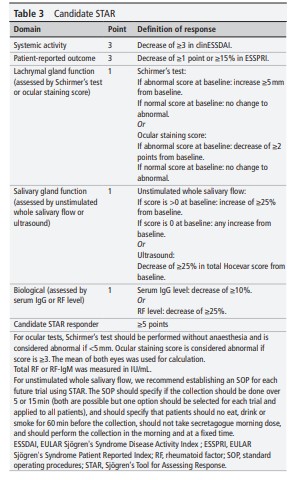
Result description
STAR is a major methodological advance for Sjögren’s disease because it was designed to overcome long-standing limitations of previous trial endpoints, namely high placebo responses, fragmented assessment of symptoms versus systemic activity, and the failure to capture glandular and biological changes in a single measure. Developed using re-analyses of nine randomised trials and extensive consensus work with clinicians, scientists, and patients, STAR integrates five core disease domains, systemic activity, patient-reported symptoms, glandular function, and biological markers, into one composite responder index intended for use as a primary endpoint in clinical trials. Its planned influence is to improve the sensitivity and credibility of efficacy assessments, enable detection of therapeutic benefit across the full spectrum of patients (including those with high symptom burden but low systemic activity), and facilitate regulatory acceptance by providing a rigorous, patient-relevant, and globally interpretable outcome measure; ultimately accelerating drug development and the likelihood that disease-modifying therapies for Sjögren’s syndrome can be demonstrated and approved.
Addressing target audiences and expressing needs
- Grants and Subsidies
- Other blended financing
- Collaboration
More investment into conducting more research activity into developping more relevant score such as STAR to capture all the complexities of the disease in order to expand the therapeutic landscape.
- Public or private funding institutions
- Research and Technology Organisations
- Academia/ Universities
R&D, Technology and Innovation aspects
TLR 6 Demonstrated in relevant environment – this means that STAR has already been used in new clinical trials in Sjogren’s disease for now as a secondary endpoint and once publication made to validate it as a primary endpoint it shall be used as such in planned Sjogren’s trials.
STAR is replicable, as it is based on standardized variables and algorithm-driven scoring, enabling consistent application across cohorts and trials. When implemented with harmonized data and defined protocols, it produces reproducible and comparable results across different clinical and research settings.