Result description
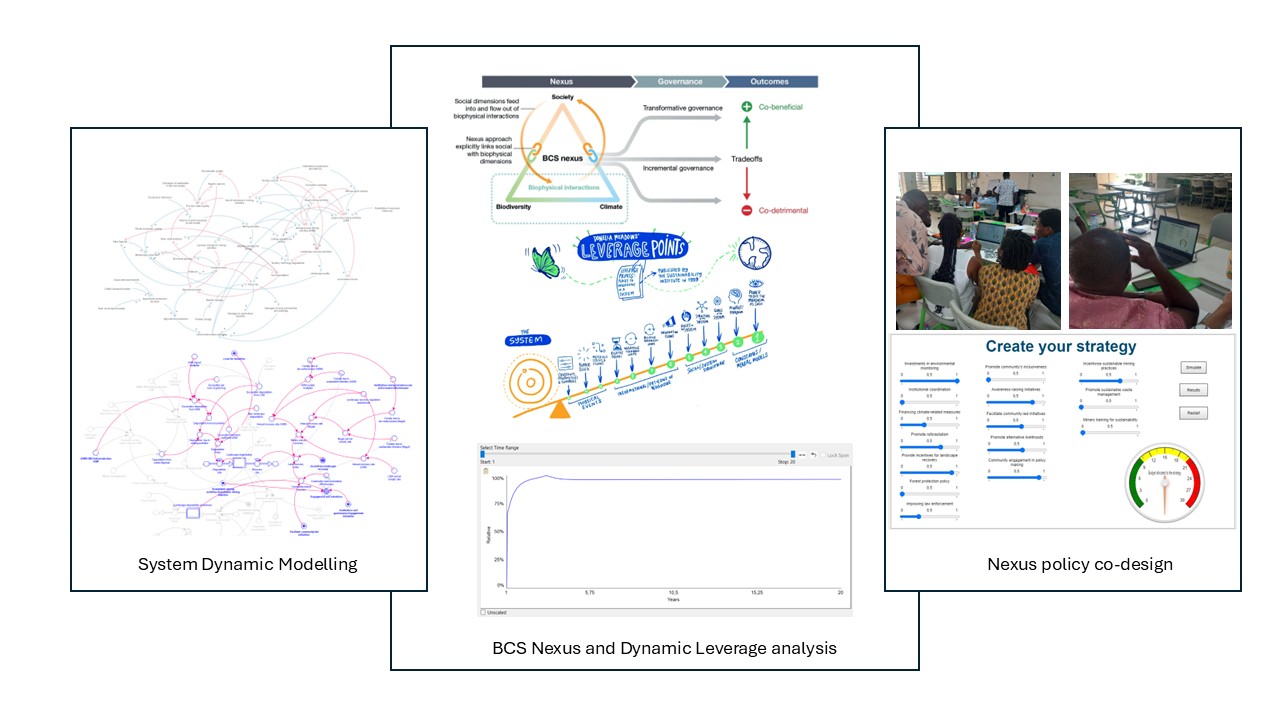
The BIOTRAILS PSDM Framework is a transdisciplinary methodological package designed to operationalise research within the Biodiversity-Climate-Society (BCS) Nexus. The result consists of:
Co-design Protocol: A structured approach for establishing participatory modelling to capture local knowledge and socio-economic drivers.
Integrated Modeling Architecture: A technical workflow coupling qualitative Causal Loop Diagrams (CLDs) with quantitative Stock and Flow Diagrams (SFDs). It integrates multi-source scientific data, including LCA impacts, EEMRIO trade flows, and SEM behavioural analysis.
Simulation Engine: A validated set of system dynamics models tested across four diverse value chains (Cocoa, Gold, Fisheries, and Handicrafts). This allows for “what-if” scenario testing of policy interventions and climate shifts.
The framework was finalized through a rigorous validation process, ensuring mathematical outputs align with stakeholder-observed realities. The result is a scalable methodology that translates the complex Nexus into a visual decision-support tool, moving from theoretical assessment to transformative action.
Addressing target audiences and expressing needs
- To raise awareness and possibly influence policy
- Fellowship to advance my/our research
The BIOTRAILS PSDM Framework serves three key groups:
Policy Makers: Need to visualize trade-offs between climate and biodiversity to design coherent “nature-positive” strategies.
NGOs & Civil Society: Require robust, evidence-based tools for advocacy. They need to integrate local knowledge with scientific data to empower communities and monitor value chain impacts independently.
Researchers: Need a validated methodology to bridge the gap between quantitative data and qualitative stakeholder input for socio-ecological modeling.
- EU and Member State Policy-makers
- International Organisations (ex. OECD, FAO, UN, etc.)
- Academia/ Universities
Result submitted to Horizon Results Platform by CONSIGLIO NAZIONALE DELLE RICERCHE