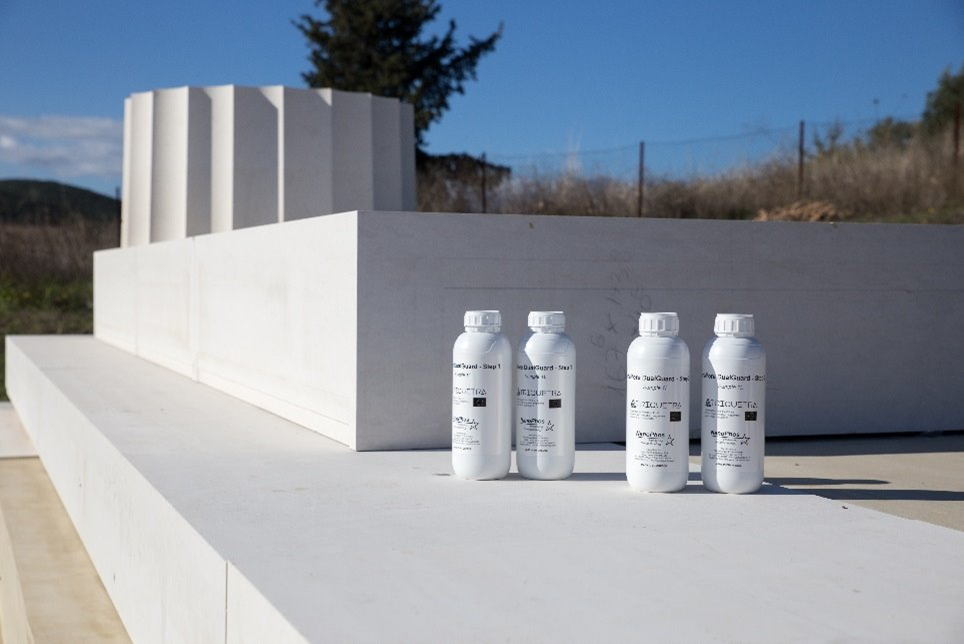
Result description
This solution delivers a portfolio of protective and consolidating materials for cultural heritage substrates (stone, brick, mortars, concrete) exposed to climate- and pollution-related stress. It includes hydrophobic coatings, consolidants, anti-corrosion/barrier layers, and UV/soiling-resistant coatings designed to be compatible with historic materials and conservation requirements (authenticity, breathability, minimal visual impact). Development is supported by a structured workflow covering material characterisation, formulation tuning, application protocols, accelerated ageing tests, and feedback to quantify deterioration reduction. It is embedded in TRIQUETRA by providing performance assumptions for several scenario analyses, appearing as mitigation options in the DSS, and being documented via technical sheets and guidance hosted in KBP. It enables practical, evidence-backed interventions targeted where risk is highest.
Addressing target audiences and expressing needs
- Help in technical expertise
- Use of research Infrastructure
- Collaboration
We seek pilot sites and conservation practitioners to validate application protocols and performance on real CH substrates (stone, brick, mortars, concrete). We also look for labs/infrastructures for advanced characterisation and accelerated ageing, plus industrial partners to support scale-up, quality control, and route-to-market (manufacturing, packaging, application services) while ensuring compatibility with heritage conservation standards.
- EU and Member State Policy-makers
- Other Actors who can help us fulfil our market potential
- Research and Technology Organisations
R&D, Technology and Innovation aspects
Portfolio of protective/consolidating materials developed with documented formulations and application protocols, supported by laboratory characterisation and accelerated ageing testing to assess durability and compatibility with CH substrates. Performance assumptions are integrated into TRIQUETRA risk scenarios and mitigation selection, with technical guidance hosted in KBP.
Yes — once formulations and protocols are finalised, materials can be manufactured at scale and deployed across many sites; standardised technical sheets and QC/testing pathways support repeatable adoption.
This portfolio can be sustained through commercialisation of product lines (coatings, consolidants, barrier layers) combined with professional application services and maintenance cycles. Long-term sustainability can include: (a) product sales via distributors/heritage suppliers, (b) licensing or manufacturing partnerships for scale-up, (c) service contracts with site owners for application + periodic re-application/inspection, and (d) training/certification for conservation practitioners to ensure correct use. The value proposition is reduced avoidable damage and fewer intrusive interventions, supporting predictable demand where climate and pollution risks are increasing.