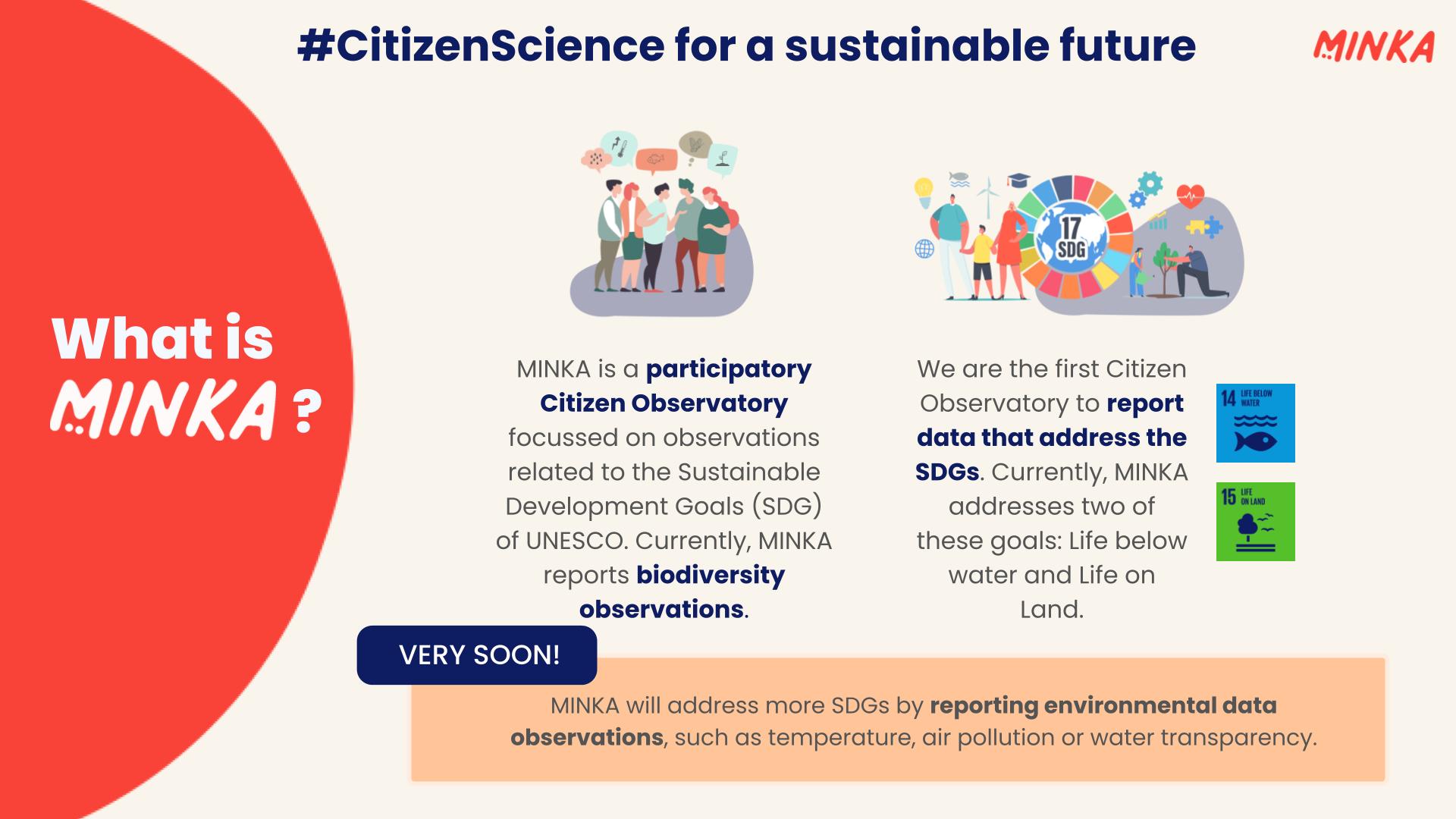
Main features: MINKA is on-site data collection and a community engagement tool that supports citizen science. The platform allows collaborative validation of observations and knowledge exchange.
Objectives: Support data management and exchange of citizen science initiatives with the aim of contributing to monitoring Sustainable Development Goals (SDGs).
Advantages: MINKA is an open, free citizen science platform that offers services of data management, creation and management of projects, identification and validation of biodiversity and environmental observations.
What is new: MINKA was launched in 2022, it is a tool in constant co-design and development. As part of the GUARDEN results, MINKA integrates AI functionalities for the identification of the citizen generated observations.
Why is it important: citizen observatories like MINKA are the essential infrastructure that support citizen science.
Addressing target audiences and expressing needs
- To raise awareness and possibly influence policy
- Collaboration
We seek to engage EU and Member State policy-makers to integrate MINKA’s citizen science approach into biodiversity monitoring and coastal management, showing how community data can meet EU reporting requirements cost-effectively. We need UN, UNESCO and OECD to recognize and promote our model as scalable for SDG monitoring and ocean conservation. We seek funding to scale across Europe. Immediate needs: policy endorsement of citizen science data, technical partners to enhance the platform, research collaborations to validate the methodology, and financial support to expand beyond Barcelona.
- EU and Member State Policy-makers
- Research and Technology Organisations
- Academia/ Universities
R&D, Technology and Innovation aspects
Over the next three years, MINKA will focus on enhancing its technological capacity, usability, and contribution to decision-making. A key line of work is the implementation of the environmental variables module, moving from prototype to full integration, enabling contextual data collection that supports use cases like BioPlatgesMet—where citizen data informs coastal management.
MINKA already supports more than 200 citizen science initiatives created on the platform and is evolving into a scalable research infrastructure that can inform policy-making. With an API, scalable web platform and mobile app, it enables data collection, integration and visualization through dashboards that act as a Decision Support Application. We are developing a business model where large projects contribute financially to sustain the infrastructure, while governmental support is required for recognizing MINKA as a long-term research infrastructure for environmental data monitoring.
Yes, MINKA and its citizen observatory with dashboard are fully replicable to other municipalities, ecosystems and thematic areas. The platform, mobile app and API allow data collection on any species and support any geographical location. More than 200 initiatives already use MINKA, proving its flexibility and scalability. To ensure policy impact, what is needed is support to accompany decision-makers in integrating the dashboard into their workflows, along with training and capacity building to interpret and use citizen-generated data.
MINKA is currently sustained mainly through project-based funding and, to a lesser extent, through support from the Spanish research agency CSIC via researchers. However, this model is not enough to ensure long-term sustainability. To operate as a stable research infrastructure that supports citizen science, environmental monitoring and policy-making across Europe, MINKA requires predictable funding streams. Stable support is not yet established and must come from institutional bodies and national governments. Such backing would allow MINKA to consolidate its infrastructure, guarantee maintenance, expand services, and provide continuous training and support to decision-makers, allowing citizen-generated data to become a permanent component of environmental governance.
- Europe