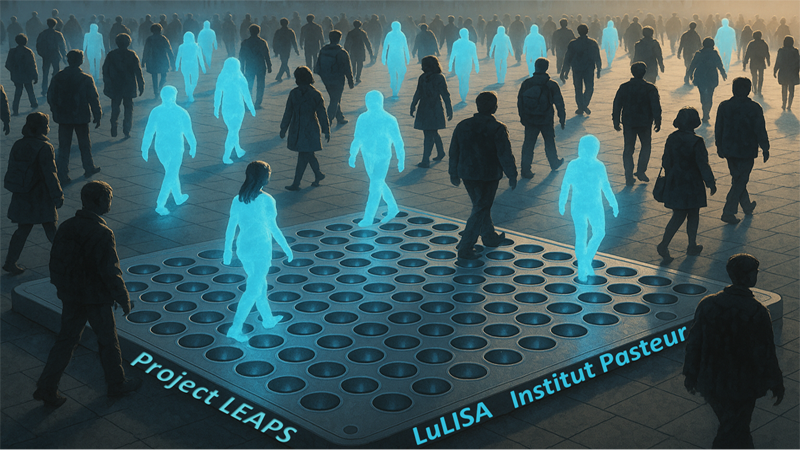
The LEAPS project (LEarning and Adaptive European Pandemic Preparedness System) aims to strengthen EU health security by creating an adaptive network for genomic surveillance, immune response monitoring, and rapid countermeasure development.
Within this framework, Work Package 2 (WP2), led by Institut Pasteur, develops LuLISA, a next-generation immunoassay platform combining high sensitivity, speed, and scalability. LuLISA uses VHH single-domain antibodies fused to a bright luciferase reporter, enabling ultra-sensitive detection (femtomolar range) and high-throughput processing (2,300 tests/hour).
LuLISA has been applied to SARS-CoV-2, influenza and RSV, with planned extension to emerging climate-driven viruses such as West Nile virus. It also supports point-of-care testing via rapid formats like LuLiFlash.
To demonstrate real-world value, WP2 conducted a large-scale immune surveillance study in Ile-de-France, analyzing 3,000 plasma samples collected after the 2024 Paris Olympics.
To ensure sustainability, Biocellis, a start-up co-founded by Institut Pasteur, will industrialize and deploy LuLISA-based kits, reinforcing Europe’s diagnostic autonomy and pandemic preparedness.
Addressing target audiences and expressing needs
- To raise awareness and possibly influence policy
Needs to extend LuLISA’s use beyond the LEAPS project through partnerships for:
1.Technical development – expand test panels to new pathogens, automate workflows, and stabilize reagents for for large-scale production and global deployment.
2.Regulatory compliance – achieve CE-IVDR certification and harmonize protocols across Europe and internationally.
3.Industrial scalability – build EU-based production and secure the supply chain to prevent shortages during crises.
4.Strategic integration – embed LuLISA into routine surveillance systems, backed by sustainable funding and strong partnerships.
- EU and Member State Policy-makers
- International Organisations (ex. OECD, FAO, UN, etc.)
- Research and Technology Organisations
R&D, Technology and Innovation aspects
This study shows that large-scale multi-analyte serology using LuLISA greatly improves epidemic preparedness. Biocellis, co-founded by Institut Pasteur, holds the exclusive license to produce and certify LuLISA kits and derived technologies and products as the LuLiFlash for extending instant diagnostics at the point of test for more infection agents for strengthening global health response.
LuLISA’s scalable business model combines diagnostic kit sales for laboratories, portable point-of-care devices (LuLiFlash), and subscription-based immune surveillance data services for governments and health agencies. Biocellis, co-founded by Institut Pasteur, drives EU-based production, ensuring diagnostic sovereignty and rapid response. Growth begins with EU-wide deployment, then expands globally via licensing agreements and partnerships with WHO and NGOs. This hybrid model (B2G, B2B, B2C) creates recurring revenues while supporting public health preparedness. By integrating LuLISA into national surveillance systems and veterinary/One Health markets, it builds a sustainable ecosystem for pandemic response, strengthens Europe’s autonomy, and delivers affordable, scalable solutions worldwide.
As illustrated along the LEAPS project by the development of high sensitivity SARS-CoV2 then influenza infection tests based on high-affinity VHH ligands, LuLISA’s results are highly replicable thanks to its standardized protocols, modular design, and scalable production. The technology uses bacterially produced VHH antibodies and luciferase enzymes, making manufacturing low-cost and easy to transfer globally. Its adaptability allows rapid development of tests for different pathogens using the same platform, supporting human, animal, and environmental surveillance. The integrated workflow—from laboratory assays to point-of-care LuLiFlash devices—can be replicated across EU Member States and internationally with minimal infrastructure. By sharing validated methods and data standards, LuLISA enables harmonized surveillance systems, ensuring consistent performance and fostering global health preparedness.
LuLISA’s sustainability comes from its flexible, low-cost technology, scalable for multiple pathogens using the same core components. Its production relies on bacterial systems, ensuring affordability and rapid scale-up. The business model combines recurring revenues from kit and device sales with subscription-based data services and public health contracts, creating financial stability. By addressing both pandemic preparedness and routine surveillance, LuLISA remains relevant beyond crisis periods. EU-based manufacturing through Biocellis strengthens diagnostic sovereignty, while global licensing and partnerships expand reach. This integrated approach ensures long-term impact, resilience, and continuous innovation.
- Global
- Europe