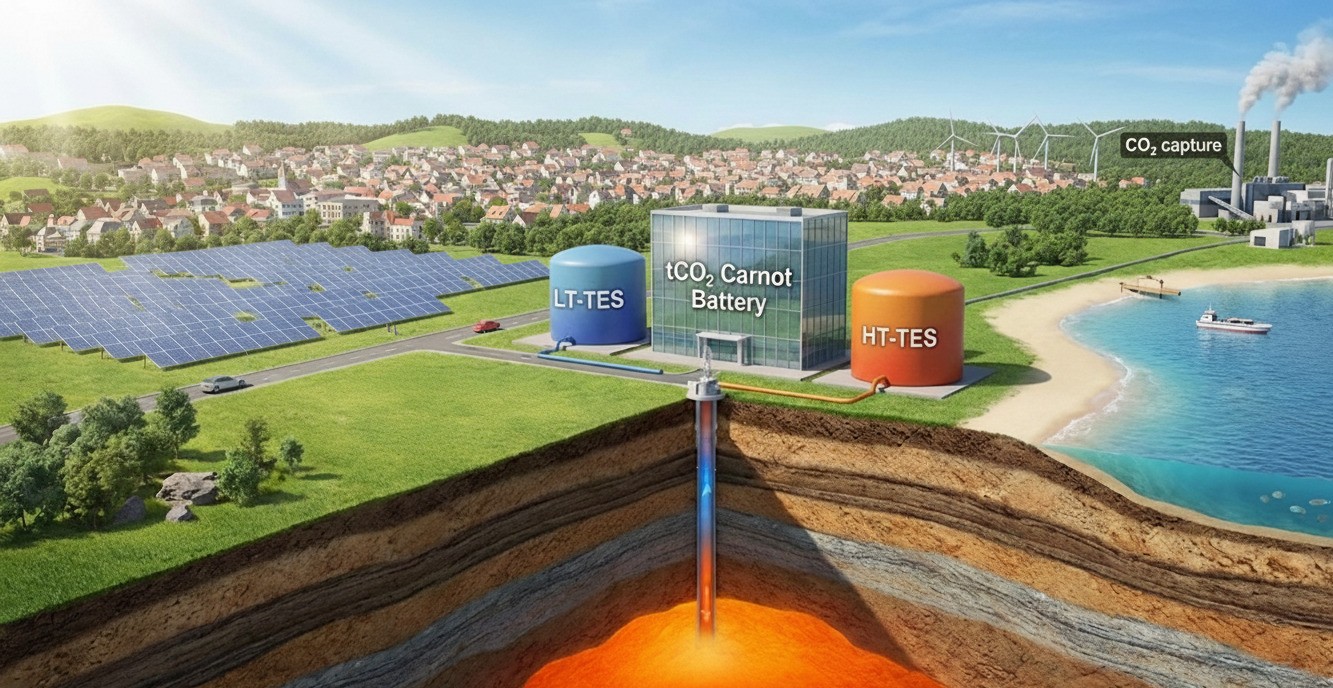
Result description
A holistic solution that simultaneously addresses two critical challenges: large-scale energy storage and net emission reduction through geological CO₂ storage. It represents an integrated platform that adds value by combining the challenges of decarbonisation, energy storage, and emissions reduction within a single infrastructure, and is ready for demonstration and scale-up. The initial system concept has progressed significantly towards a higher TRL, supported by validation of costs, efficiencies, and integration scenarios. LCA for different plant scales and market configurations (grid, PV, wind) has been completed. A cross-national empirical assessment has been conducted and confirms a growing acceptability of CEEGS technology as a TES solution. Several cross-sectoral deployment opportunities have been identified, including applications in industrial process decarbonisation, distributed generation, and CO₂ transport systems.
Addressing target audiences and expressing needs
- Grants and Subsidies
- Other blended financing
- Fellowship to advance my/our research
Funding, financing, or cooperation to investigate new applications, such as integration with capture plants and coverage of thermal demand for cooling and heating, and the further development of the technology to a higher TRL.
- Public or private funding institutions
- Research and Technology Organisations
- Academia/ Universities
R&D, Technology and Innovation aspects
CEEGS developed a scalable energy storage system utilising CO₂ for power, heat, and cooling, and for partial CO₂ sequestration. A 20 kWe demo raised the tech to TRL4 (EU validation). Next: new research into integration with capture processes and thermal demand coverage (heating and cooling) for industrial processes, in parallel with the development of a demo plant and business plan to reach TRL6.
- Applications from a few kWh to several MWh storage,
- Capacity to store several Mtpa of CO2
- Flexible storage duration from hours to weeks,
- Modular construction possible
- Adaptable power ratings
- Standardisation potential
·Modular system design,
·Easy to scale up or down based on local energy demand and storage needs,
·Connection of renewable power plants, industrial CO₂ sources, including cleaning, as a source of the CO2 and a possible user of the stored energy, or district heating/cooling networks without major redesign,
·store excess electricity from any source, improving grid stability in various energy mixes,
·CO₂ injection, geothermal heat extraction, and underground storage already have industrial analogues in oil & gas, CCS (Carbon Capture & Storage), and geothermal power.
·Standardised designs for specific storage volumes, reservoir types, and power ratings can be developed, enabling faster rollouts.
·Storage technology without the use of rare earths,
·No ignition or flammability, as CO2 is an inert gas
·No toxic media used
·CO₂ sequestration – decarbonisation of hard -to-abate industry, and possibly negative emissions for sources relying on biomass for power generation, such as pulp&paper sector or waste-to-energy sector
·Excess green electricity, no backup from fossil fuel
·new value chains in renewable energy, energy storage, and CO₂ management