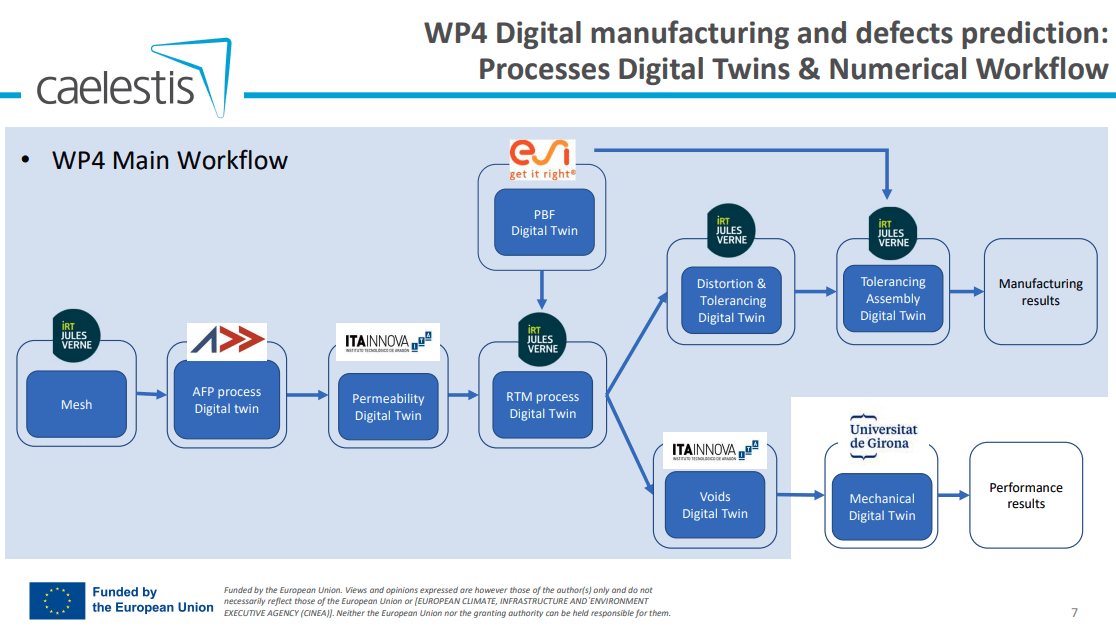
This result establishes a comprehensive numerical workflow strategy and programming framework that links Digital Twins across the full manufacturing chain of an Outlet Guide Vane (OGV). It combines two core innovations:
- Workflow Connectivity: A strategy to exchange data between Automated Fiber Placement (AFP), Resin Transfer Molding (RTM), and Assembly stages.
- Defect Modelling: A specific strategy to model and propagate process defects from one stage to the next (e.g., tracking how AFP defects influence RTM behavior).
The solution utilizes Python-based orchestration to bridge commercial and research solvers (ADDPATH, PAM-RTM, PAM-DISTORTION, ALYA, Twinkle, MECAMASTER). It ensures cross-process continuity, allowing for the full simulation of the OGV manufacturing process by connecting previously isolated simulation silos.
Addressing target audiences and expressing needs
- Collaboration
We specifically need / are looking for:
- Aerospace Manufacturers (OEMs/Tier 1): Partners to provide industrial use-cases (e.g., OGV) to validate our cross-process defect propagation strategies and help advance the workflow from TRL 4 to TRL 6.
- Software Vendors: Collaborators to expand the interoperability of our Python orchestration engine beyond current solvers (AddPath/PAM-RTM) via API integration.
- R&D Partners: Collaborators for HORIZON-CL4-2027-04 (AI-Driven Robotics), specifically experts in robotic control and sensors to automate the simulation-hardware feedback loop.
- Others/ No specific audience
- Research and Technology Organisations
- Academia/ Universities
R&D, Technology and Innovation aspects
The “Link-AFP-RTM” numerical workflow has been successfully developed and validated in a controlled laboratory environment. The Python-based orchestration engine is fully functional and currently capable of:
- Extracting porosity and fiber orientation data from AFP simulations (AddPath).
- Mapping this data onto RTM meshes.
- Running coupled flow simulations in PAM-RTM.