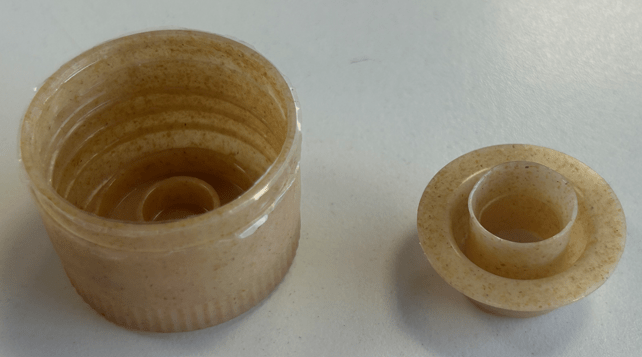
We have developed two innovative bioplastic closures:
- A premium cap for limoncello
- A pourer and capsule system for extra virgin olive oil
Both are crafted from PHB and natural fillers such as rice husk, offering an environmentally responsible alternative to traditional plastics—without compromising on quality or performance. The olive oil cap process includes the use of Microwaves Technlogy to enhance material performance.
They meet sector’s expectations in critical areas and are going to be backed by laboratory validation, including permeability testing, migration analysis, and material characterization, ensuring full technical reliability.
Addressing target audiences and expressing needs
- Business plan development
- Expanding to more markets /finding new customers
- Collaboration
We’re seeking strategic partners who are passionate about developing innovative solutions for the oil and liquor industries— custom bottle caps tailored to evolving market demands.
Our goal is to identify the most suitable bioplastic: one that is safe for food contact, consumer-friendly, aesthetically appealing, and sustainably sourced.
To achieve this, we seek collaborators to support us in laboratory testing, including permeability, food contact compliance, and material characterization.
Let’s work together to develop the next generation of sustainable closures.
- Other Actors who can help us fulfil our market potential
- Research and Technology Organisations
R&D, Technology and Innovation aspects
Prototypes and final lab testing.
Yes, it is a scalable business model, particularly because the production leverages existing industrial technologies (injection moulding), uses commercially available bio-based materials, and addresses growing market demand for sustainable packaging—making it easily adaptable for large-scale manufacturing and global distribution.
Yes, the result is replicable by others with access to the right bioplastic formulation, processing expertise, and regulatory compliance knowledge, but it requires specific technical know-how and validation to achieve the same performance and quality
Yes, both the result and the business model are designed for long-term sustainability, because the bioplastic closure is made from renewable, non-fossil-based materials with a lower carbon footprint, while the business model aligns with global trends toward eco-regulation, circular economy, and consumer demand for sustainable products—ensuring environmental, economic, and market relevance over time.