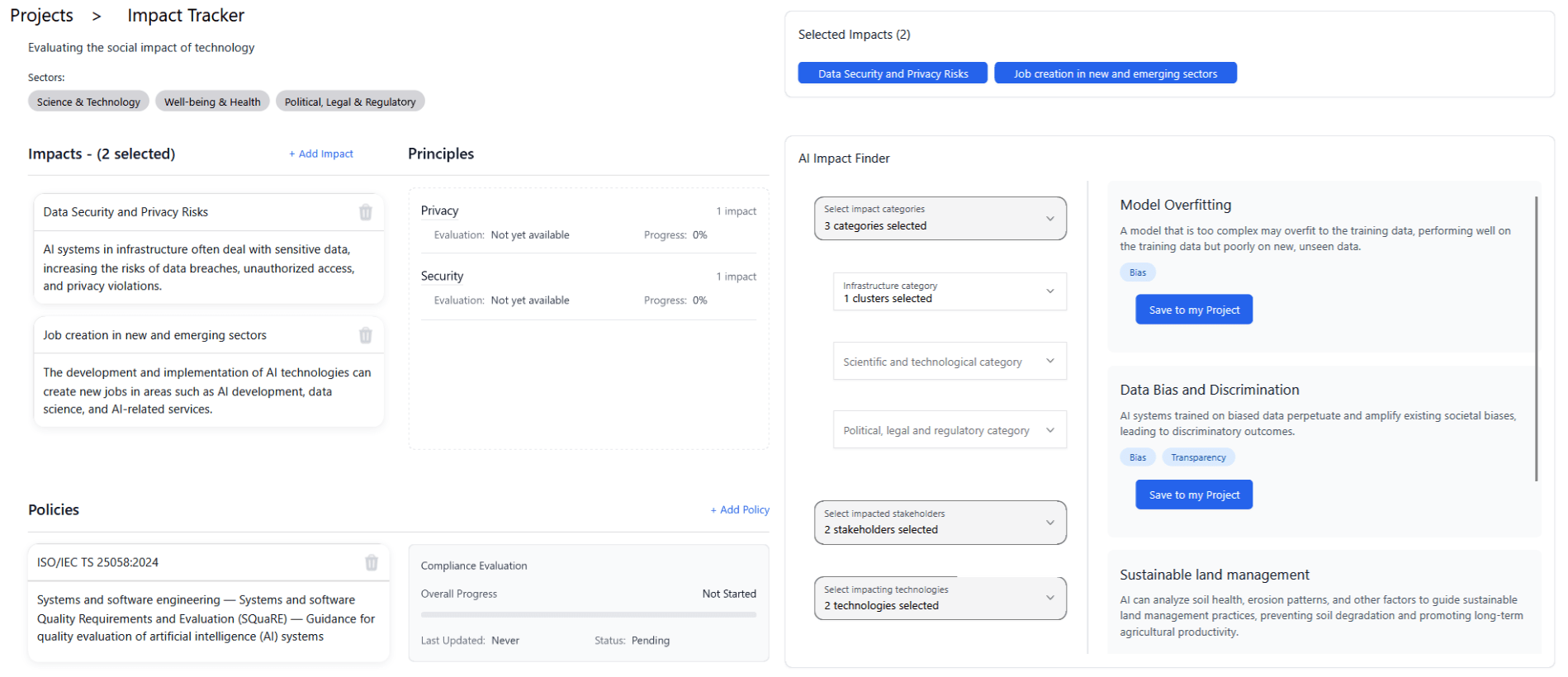
Result description
Within the LUCIA project, ImpactRadar is used to assess the social and ethical impact of the AI model developed for lung cancer risk prediction. Tailored to the healthcare context, the tool provides a dynamic evaluation of bias mitigation, explainability, and transparency throughout the AI development process. By applying ImpactRadar, project partners are able to identify potential sources of bias early on, improve the interpretability of AI decisions for clinicians, and ensure transparency in how patient data is used. The tool supports internal reflection and alignment with best practices through peer benchmarking and tailored guidance. As the project progresses, ImpactRadar strengthens the trustworthiness and ethical integrity of LUCIA’s AI components—laying the groundwork for responsible implementation in future lung cancer screening programs. Its use enhances stakeholder confidence and supports the development of AI that aligns with core values in medical innovation. The ImpactRadar tool is used in another EU funded health project as well, called REALM.
Addressing target audiences and expressing needs
- Business partners – SMEs, Entrepreneurs, Large Corporations
- Legal / IPR advise
- Expanding to more markets /finding new customers
Sector based customers – finding new markets for our AI Impact Assessment
- Public or private funding institutions
- Other Actors who can help us fulfil our market potential
- Research and Technology Organisations
R&D, Technology and Innovation aspects
The tool has been developed, tested and validated. We are about to launch and operate it across different sectors.
The AI Impact Radar tool is designed with replicability in mind. Its core methodology, including the AI impact assessment criteria, assessment procedures, and scoring logic, is fully documented and follows a structured and transparent process. The tool can be applied consistently across different AI systems, and when used under the same input conditions and configuration settings, it yields the same results. Key components—such as the evaluation framework, underlying algorithms, and decision logic—are either open-source or can be made available upon request. This allows other researchers or auditors to independently reproduce the audit outcomes, ensuring consistency, transparency, and trustworthiness of the results.
es, both the result and the business model are designed for long-term sustainability. The AI auditing tool addresses a growing and persistent need for trustworthy, ethical, and transparent AI systems, which is increasingly reinforced by evolving regulations (e.g., the EU AI Act) and organizational governance standards. The tool is built to be modular and adaptable, allowing updates to reflect new ethical frameworks, compliance requirements, or domain-specific needs—ensuring long-term technical relevance.
From a business perspective, the model leverages scalable services such as custom audits, subscription-based access, and consultancy, allowing revenue diversification. The tool can also be integrated into clients’ internal processes or offered as part of compliance packages, ensuring continuous demand. Furthermore, the team’s expertise in responsible AI and regulatory alignment contributes to long-term credibility and market positioning.
- Global
- Europe
- Middle-East
- South America