Result description
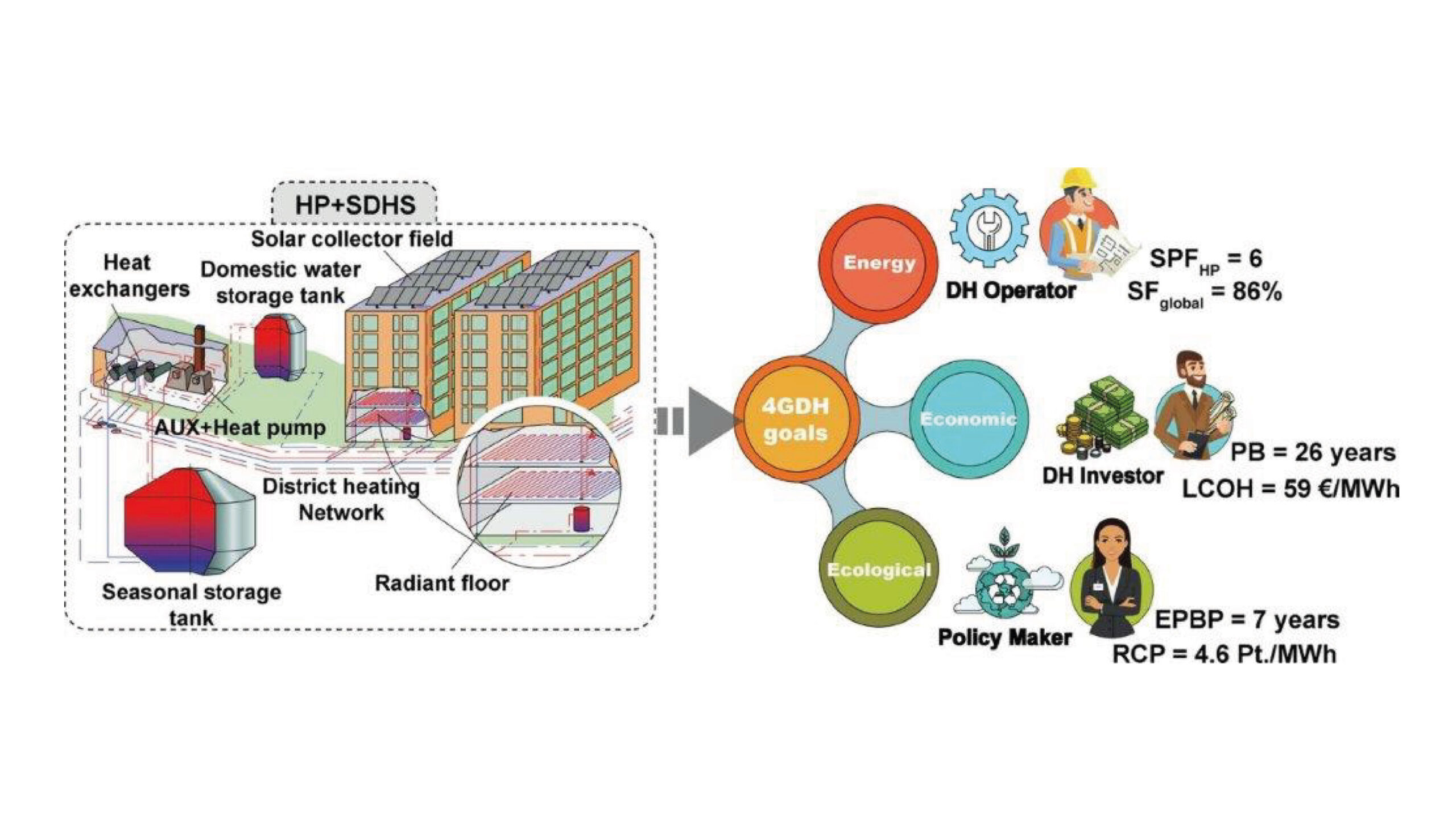
The proposed analysis is applied to a small neighbourhood of 10 residential buildings located in Madrid (Spain). Inherent the SDHS operator perspective, the results reveal a significant improvement in the stabilization of the SDHS performance due to the heat pump (HP) integration where the solar field temperature never exceeds 80oC, and the seasonal storage tank (SST) temperature stands at 85.4oC. In addition, the share of solar energy stands above 86.1% with an efficiency of 73.9% for the SST, while the seasonal HP performance factor stands above 5.5 for all optimal scenarios. From the investor viewpoint, an energy price of 59.1 Euro/MWh can be achieved for the proposed system with a payback period of 26 years. Finally, from the policymaker perspective, along with the significant economic and sustainable improvement in the SDHS performance, a substantial environmental improvement of 82.5% is achieved when compared to the conventional boiler heating system. The proposed analysis reflects a great motivation for different stakeholders to propose this system as a path toward the 4GDH in the future district energy systems.
Addressing target audiences and expressing needs
- To raise awareness and possibly influence policy
We are trying to show the potential of these tecnologies, but also that they need a considerable investment with a long term view towards the economic benefit.
- EU and Member State Policy-makers
R&D, Technology and Innovation aspects
The proposed methodology is tested in a virtual environment. The next step is to implement one of the solution with one of the construction companies.
The proposed work is tested at different climate and community sizes virtually to show the scalbility of the work.
In the real application of designing the solar district heating system, the present methodology can be beneficial to obtain the optimal sizing of the renewable energy equipment with consideration for the construction properties of the thermal energy storage at any climate conditions.
The proposed work can serve as an effective tool to sustainbility of any district heating with consideration for the market fluctuation regarding the investment cost and the energy carriers. Furthermore, it can promote a clear statement regarding the new clean energy for all Europeans packages.
- Europe
- Italy
- Spain
- Denmark
- Germany