Result description
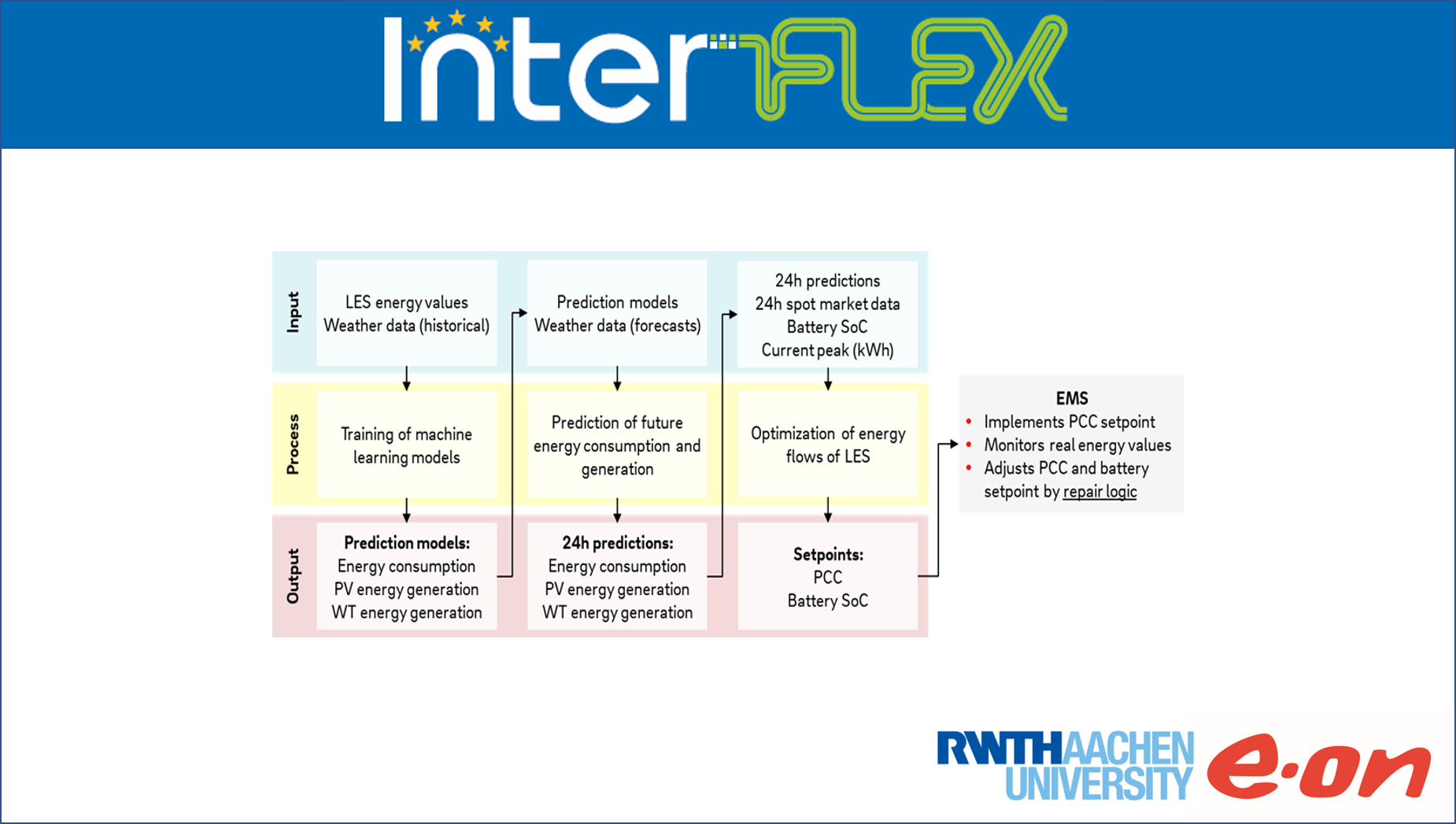
Successful development of forecasting methods that are applicable to Simris (InterFlex swedish demonstrator) and any future microgrid, and comparison between them. Methods comparison: Sequence-to-sequence RNN, Standard RNN, Random Forests, ARIMA, Exponential Smoothing. Further development of the algorithms and their implementation for other test systems are foreseen.
Development of advanced control strategies as well as data analytics algorithms was conducted to investigate how to leverage the increased ability to observe and steer a microgrid based on the distribution network requirements and constraints. This included the deployment of an electrical grid model of the Simris trial site (demo site of the InterFlex project in Sweden) to simulate grid behaviour.
Two forecasting techniques were evaluated: while both techniques are using a sequence-to-sequence learning approach, one is based on recurrent neural networks (RNN) and the other one is based on convolutional RNN which aims at exploiting spatio-temporal dependencies. To optimize the system operation, a model predictive control (MPC) approach is used. Based on the simulation of the grid model, the controller optimizes its control input at each time-step in a receding horizon fashion. One major advantage is that the approach facilitates to easily incorporate forecasting methods. Moreover, the implementation allows to optimize various different objectives, such as potential islanding time maximization or loss minimization.
Addressing target audiences and expressing needs
- We are sharing our knowledge
DSO, Local energy communities, distributed generation operators
- Others/ No specific audience
Result submitted to Horizon Results Platform by E.ON SVERIGE AB