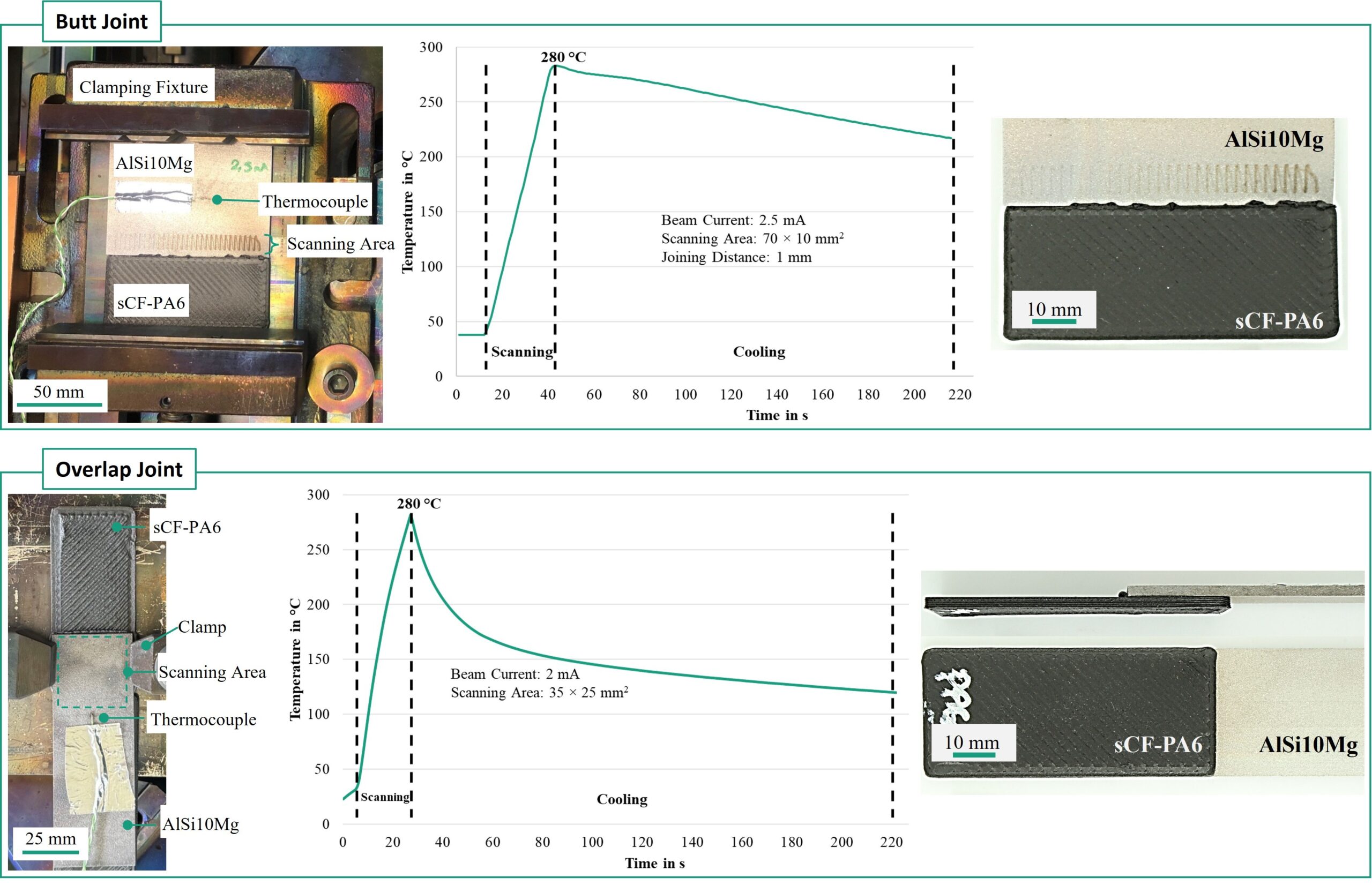
Electron Beam Bonding has the potential to effectively join additively manufactured carbon fiber-reinforced thermoplastic composites with aluminum alloys, achieving a maximum lap-shear strength comparable to the tensile strength of the short carbon fibers, without requiring any surface treatment. Using this method, additively manufactured aluminum alloys were successfully bonded with both short- and continuous-fiber composites (sCF-PA6, cCF-PA6, sCF-PEKK, cCF-PEKK). Lap-shear tests showed that the short-fiber-reinforced composites failed within the composite material itself, indicating that the joint strength exceeded the tensile strength of the composite substrates.
Despite its high cost, electron beam technology is an effective tool for developing and testing joining processes for sensitive materials. It allows the precise determination of optimum joining temperatures, heating rates, and strategies.
Addressing target audiences and expressing needs
- Business partners – SMEs, Entrepreneurs, Large Corporations
- Expanding to more markets /finding new customers
- Collaboration
- Industrial partners and real product use-cases requiring reliable joining of thermoplastic and aluminium components
- Application areas where lightweight design and improved thermal management are critical,
- Collaborators from research centres, universities, SMEs, and large companies to validate and further develop the technology
- Other Actors who can help us fulfil our market potential
- Research and Technology Organisations
- Academia/ Universities
R&D, Technology and Innovation aspects
Fraunhofer IPK has demonstrated that thermoplastic composites reinforced with short and continuous carbon fibres can be reliably joined to aluminium using electron beam welding, with repeatable results on simple and semi-complex geometries. Next, the process will be applied to complex shapes and verified through mechanical and thermal testing for industrial use.
Replicability means that the electron beam bonding process can be repeated with similar results in different settings. It indicates that other teams or facilities should be able to use the same parameters and achieve comparable bonding quality. This helps show that the method is practical and can work beyond the initial tests.
The technology supports long-term sustainability because it enables lightweight multi-material designs, which can reduce material use and improve energy efficiency in final products. The process itself requires no additional joining materials, such as adhesives, which lowers waste and simplifies recycling. As the method can be integrated into existing manufacturing environments, it also supports sustainable industrial adoption without major resource demands.