Result description
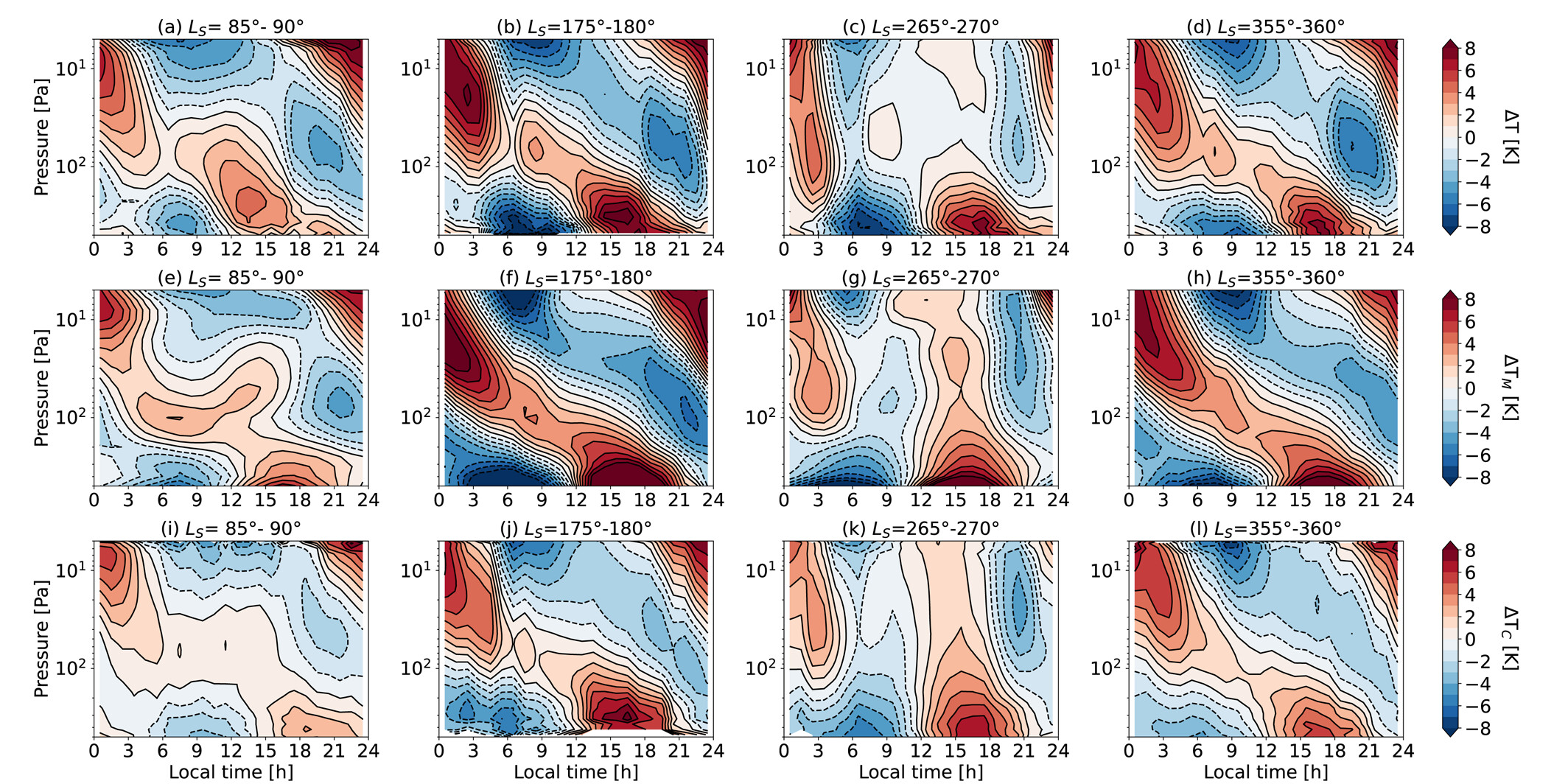
As a result of Mars’ planetary rotation of ∼24.6 hr and the low mass of its atmosphere, the atmospheric temperature changes dramatically every day following the cycle of the incoming sunlight. Such rapid and large changes, together with dust and clouds, can excite a number of waves propagating in the Martian atmosphere. These strong waves are one of the key factors controlling the weather and climate on Mars. However, our understanding is currently limited due to the lack of observations. A recent spacecraft mission located in an orbit distant from Mars has largely solved this problem by providing observations with good coverage in both location and time, enabling the investigations on the temperature variations and waves on a global and hourly scale. Here, we present the results of such investigations during the first Martian year of this mission, as well as comparison with the outputs from a Mars climate model, which represents our current knowledge. The model and the observations show generally good agreements, with differences suggesting directions in future model improvements, among which are the location and time of the dust and clouds in the Martian atmosphere.
Addressing target audiences and expressing needs
- Collaboration
This result targets the planetary science community. Applying it to a larger scale and scientific collaboration are appreciated.
- Research and Technology Organisations
- Academia/ Universities
R&D, Technology and Innovation aspects
Techniques developed in this work has been well applied to the migrating tide analysis on Mars. I will be applied to other wave analysis in the next step.
All results are fully replicable if following the technique and data described in the journal publication.
The results have great significance in future Mars exploration.