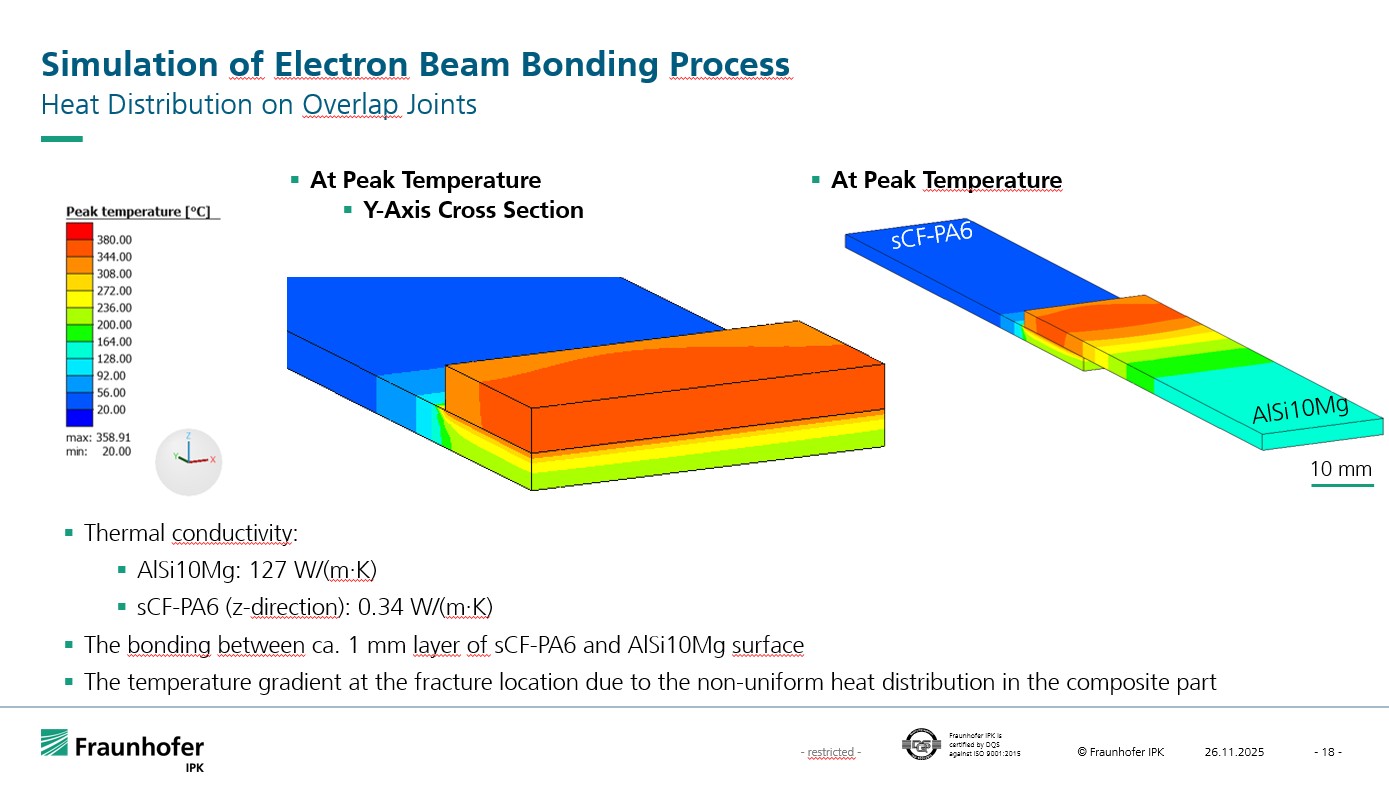
Fraunhofer IPK has successfully developed and validated the simulation model for the Electron Beam Bonding (Welding) process, demonstrating excellent agreement with experimental measurements. The model effectively addresses the challenges of joining carbon fiber-reinforced thermoplastic composites with additively manufactured aluminum alloys, accounting for the anisotropic thermal behavior of composites and the isotropic properties of metals. By predicting heat distribution across the metal and composite layers, the simulation enables controlled adhesion in overlap joints, allowing selection of optimal bonding parameters while minimizing experimental effort and cost. This tool provides a reliable method for designing and optimizing multi-material joints with improved process control and performance.
Addressing target audiences and expressing needs
- Business partners – SMEs, Entrepreneurs, Large Corporations
- Expanding to more markets /finding new customers
- Collaboration
We are specifically looking for industrial partners and real product use-cases that require reliable joining of thermoplastic and aluminum components and their simulation, particularly in applications where lightweight design and improved thermal management are critical. We also seek collaborators from research centres, universities, SMEs, and large companies who can use the welding (bonding) simulation model to validate and further develop the technology.
- Other Actors who can help us fulfil our market potential
- Research and Technology Organisations
- Academia/ Universities
R&D, Technology and Innovation aspects
Fraunhofer IPK has demonstrated welding simulations of electron beam bonding for thermoplastic composites reinforced with short carbon fibers and aluminum for simple geometries. To extend this capability to complex and semi-complex shapes, the simulation models need to be further developed and refined for welding applications.
The electron beam bonding simulation is highly replicable, consistently producing reliable heat distribution and bonding results across multiple runs. This ensures confidence in process design, optimization, and scaling while reducing experimental effort.
The electron beam bonding simulation contributes to sustainability by reducing the need for extensive experimental trials, saving materials, energy, and time. By accurately predicting optimal process parameters and heat distribution, it minimizes waste of aluminum and composite materials, lowers energy consumption during bonding, and supports more efficient multi-material joint production. This approach enables environmentally conscious manufacturing while maintaining high-quality and reliable joints.