Result description
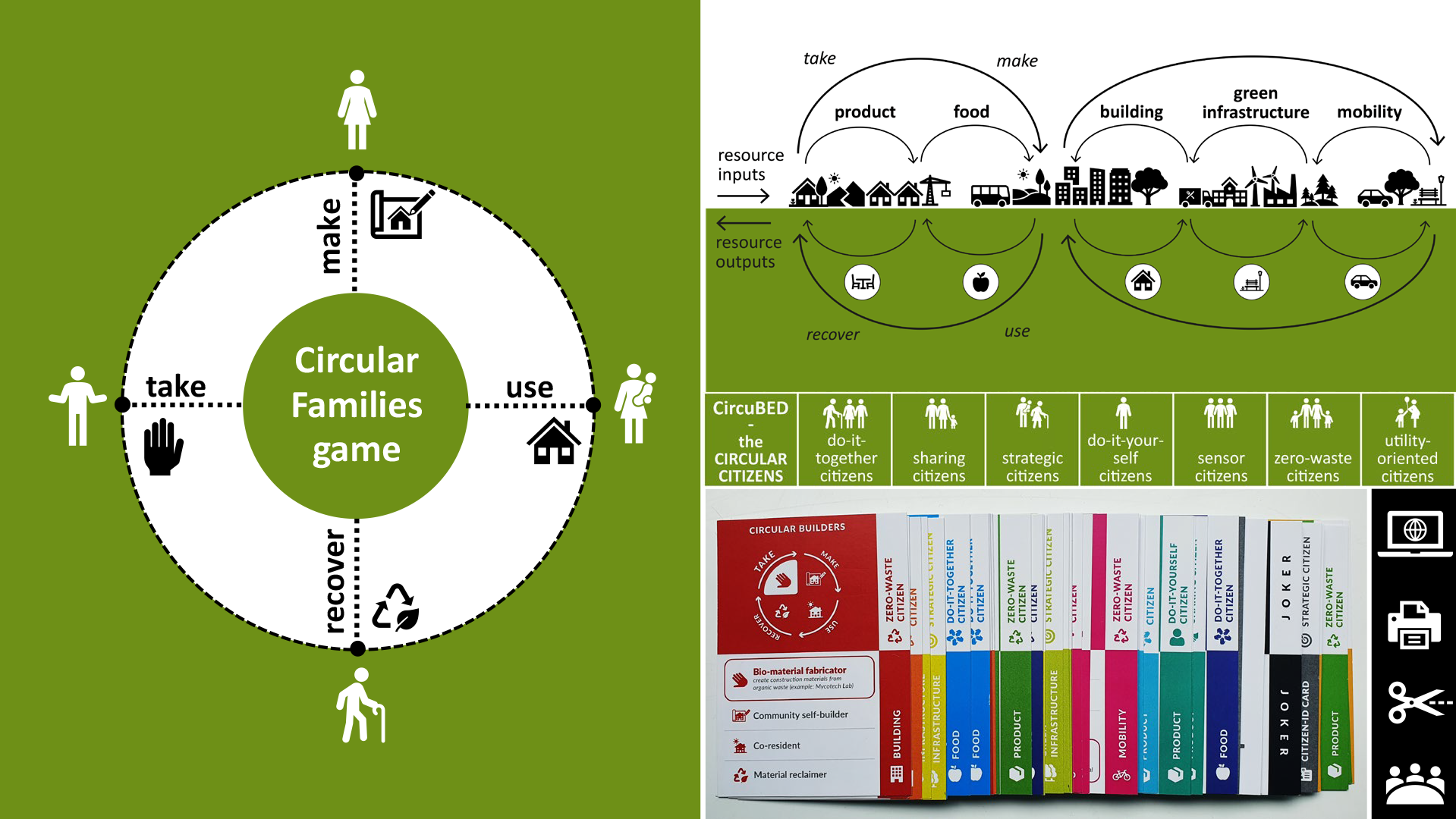
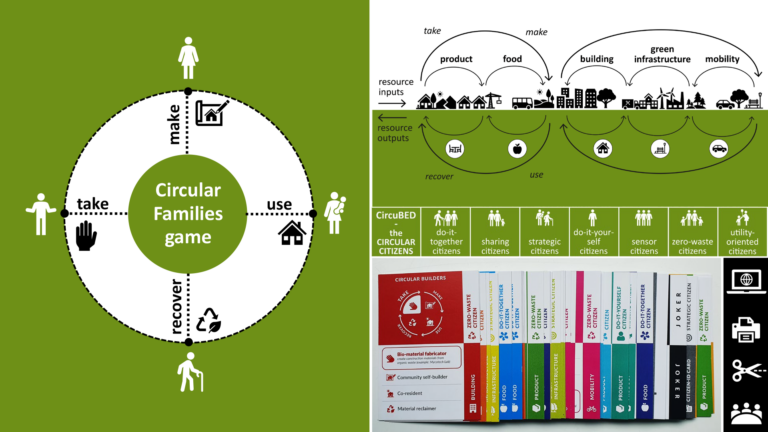
The result is a card game called Circular Families to engage citizens in discovering circular economy concepts and taking action in their cities. Each player aims to collect all 4 members from one of 13 ‘circular family’ groups that represent 5 urban sectors: construction, manufacturing, food, green infrastructure, and transport. To form a family, during each turn a player must decide on a circular action which could be ‘take’, ‘make’, ‘use’, or ‘recover’ to build a resource loop. Actions promote social innovation initiatives which engage citizens in circular practices while aligning individual interests with social and environmental benefits. Players can play two game versions. In the Circular Happy Families, players build a circular family by asking other players for a specific member in a specific family. Whoever collects the most families win. In the Circular Loopy Families, players build a circular family by bypassing cards until one builds the first family. After having played, players can select their preferred strategy, identify the related circular citizen and, through the Citizen-ID cards, discover features, actions, challenges and impact.
Addressing target audiences and expressing needs
- Collaboration
- Fellowship to advance my/our research
We are looking for a company or partner to licence the research IP for the manufacturing and selling of the product on our behalf. Users have asked to have the opportunity to buy the physical product even if the game can be freely downloaded from the project webpage for home printing. The University does not manufacture and sell products as this does not lie within its business activities (teaching, research, and societal benefits). This company or partner would have the responsibility of marketing, sales, quality control, etc. to make the physical product available in the market.
We are also looking for a fellowship to advance the research through the development of a role-playing game to facilitate citizens in co-creating social innovation interventions for a circular economy. Players will assume the role of circular citizen characters and collaboratively conceive interventions in urban sectors or across sectors to deal with specified resource scenario settings while tackling challenges commonly affecting social innovations such as the lack of local networking for resource circularity or the need for building sustainable business models and measuring impact.
- Public or private funding institutions
- Academia/ Universities
- Private Investors
R&D, Technology and Innovation aspects
The card game has been validated in the relevant environment (TRL 7) through several game sessions with a large variety of participants (citizens, groups of interest, housing associations, and students). The product at this stage is a representative prototype tested in an operational environment. All components have been integrated into a final real-scale product prototype. Robustness has been proven through multiple game sessions in a relevant working environment. The prototype shows repeatable performance in terms of user engagement and knowledge exchange. The process is reliable, and the performances match the expectations. However, other relevant parameters concerning scaling-up, environmental, regulatory and socio-economic issues have not been yet defined and qualitatively assessed. The next steps should include these aspects to qualify and prove it in the operational environment as well as cover the go-to-market activities.
The card game can be replicated, sold and delivered consistently and reliably in multiple markets in the industrialized and newly industrialized countries to serve customers at the same standard, every time. The game content is reliable for these countries since it has been developed based on the analysis of social innovation initiatives which have been developed, stabilized, diffused or completed between the 1990s-2010s in industrialized and newly industrialized countries.
Result submitted to Horizon Results Platform by CARDIFF UNIVERSITY