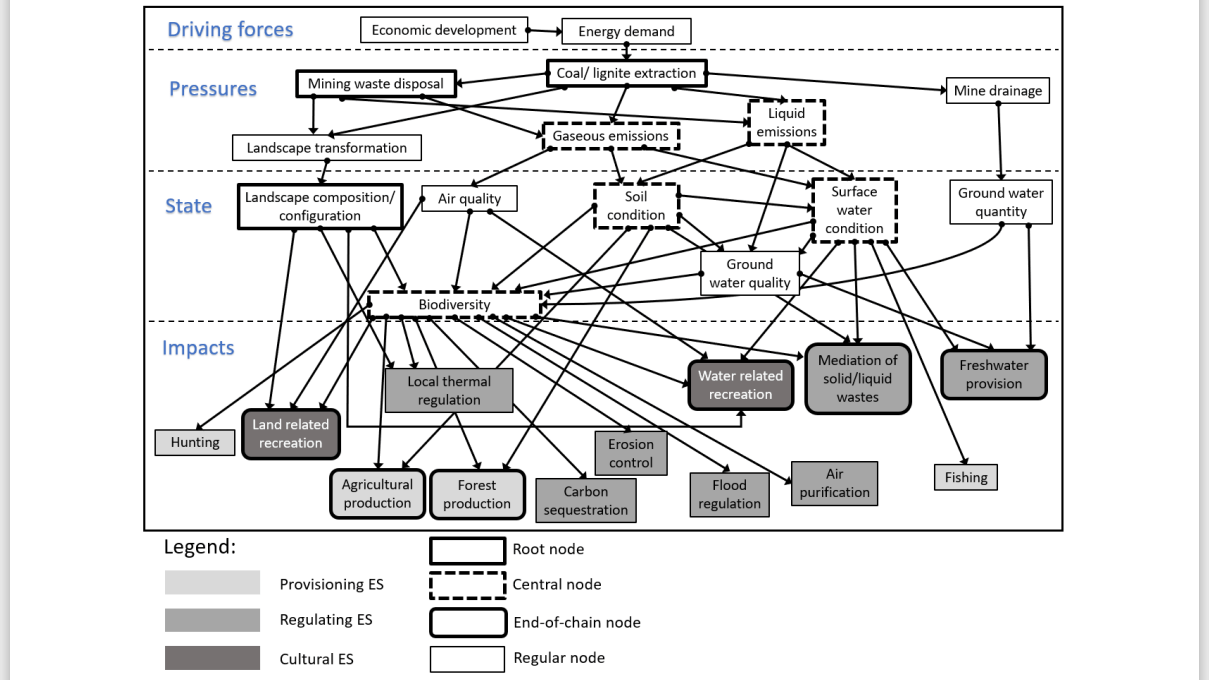
Mining in general, and particularly mining for energy resources such as coal and lignite, results in massive impacts on the surrounding landscape and ecosystems. Post-mining reclamation that takes account of the disturbed ecosystem services requires a research approach that links the mining impact to ecosystem functions and ecosystem service potentials. This methodology combines the Driving Forces–Pressures–State–Impact–Response (DPSIR) framework and the ES cascade approach by complementing the limitations of each approach with the strengths of the other. The DPSIR framework is extended to a causal network to account for the multiple interconnected causal chains of coal and lignite mining impacts. The presented causal network supports the identification of ES indicators for the assessment, planning, and monitoring of post-mining reclamation in coal/lignite mining landscapes. The presented approach can also inform political and administrative decisions by identifying the ecosystem elements at risk of being degraded from mining.
 Soil health and food
Addressing target audiences and expressing needs
- To raise awareness and possibly influence policy
State, regional and local authorities; companies working on restoration and mining industry that are decision-makers in restoration processes.
- EU and Member State Policy-makers
- International Organisations (ex. OECD, FAO, UN, etc.)
- Academia/ Universities
R&D, Technology and Innovation aspects
The methodology will be perfectioned as far as it is used in different places.
Our methodology can be adapted to the changing needs or patterns of other affected areas different from mining.
It can be applied to any mining-affected area that has to undergo restoration.
Dates or deadlines do not condition the methodology.