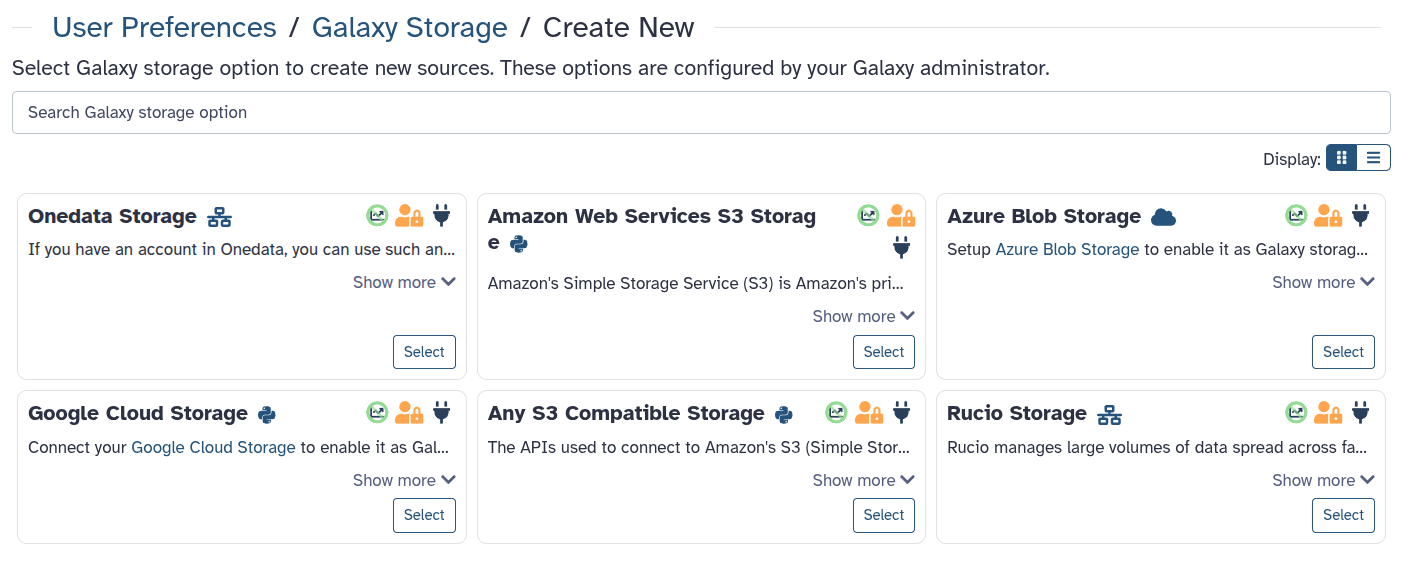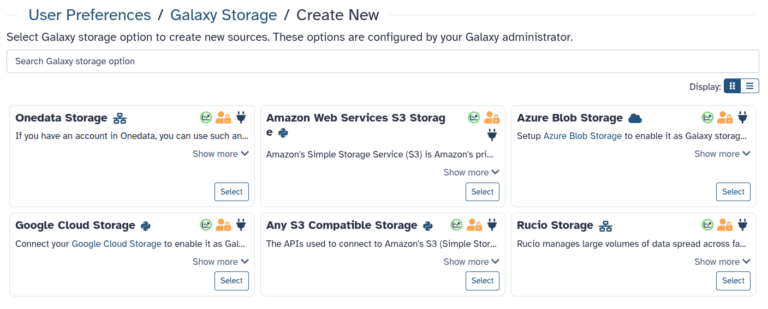
Bring Your Own Storage (BYOS) lets Galaxy users attach institutional or cloud storage and run workflows where the data lives. It supports S3-compatible object stores (incl. MinIO) and Onedata Spaces via upstream File Source and Object Store integrations. User-facing templates allow researchers (not only admins) to configure endpoints.
Addressing target audiences and expressing needs
- Use of research Infrastructure
Seeking pilot sites and partners to adopt BYOS. Target: research orgs with S3/POSIX/WebDAV storage, institutional IT/AAI (OIDC/SAML), HPC/cloud/EOSC providers, workflow devs, data stewards/DPOs. Needs: connect storage to Galaxy, run test workflows; validate connectors, throughput, egress/cost policies; test group-based authZ and auditing; share datasets (incl. sensitive) under governance; provide benchmarks and co-author case studies.
- Research and Technology Organisations
- Academia/ Universities
R&D, Technology and Innovation aspects
Deployed (TRL9) in usegalaxy.eu and other instances. Next Steps: new connectors (DRS/iRODS), egress-aware accounting, residency/audit toolkits, benchmarks, advance onboarding/training, service hardening.
BYOS scales technically and economically. Technically, it is stateless, multi-tenant and built on standard protocols (S3, WebDAV/Onedata) so new institutions can be onboarded without re-architecting. Storage endpoints add capacity rather than central load; data-local execution and caching avoid mass replication, cutting transfer/egress costs as volumes grow. Connectors and credentials are template-driven and automated (IaC), enabling self-service at user or site level. It integrates with federated AAI and group-based policies, so access control scales with organizations. Operationally, monitoring, quotas and cost-accounting keep quality and unit economics under control; each additional tenant reuses the same Galaxy stack, so marginal cost per user/dataset declines. Organisationally, open-source governance and documentation/training let providers and national EOSC nodes operate BYOS locally while sharing maintenance upstream.
BYOS is replicable as an upstream capability of Galaxy. It uses open standards (S3, WebDAV/Onedata) and ships with reference configs, Helm/Docker options and IaC playbooks so any site can reproduce the service. Admins enable File Sources/Object Stores, add endpoints via self-service templates, keep credentials in a vault abstraction, map groups via OIDC/SAML, and validate with checks and GTN tutorials. Campuses, HPC/cloud and EOSC nodes can deliver the same BYOS experience at scale, with aligned interfaces, policies and performance targets.
BYOS is sustainable long-term.
Value: Data-local analysis lowers transfers/egress and carbon, keeps data sovereign, avoids lock-in, and speeds results for researchers, IT/AAI, providers and data stewards.
Delivery: Open-source Galaxy upstream, standards (S3/WebDAV/Onedata), automation (IaC/Helm), shared runbooks and training let many operators deliver the same service with low marginal cost.
Capture: Cost-recovery for storage/egress, tiered support/SLAs, and funded onboarding via EOSC/national nodes.
Governance & impact: Audit, quotas and DPIA templates build trust; skills/community sustain operations; fewer data copies and data-aware scheduling reduce energy use.
- Europe
- Global