Result description
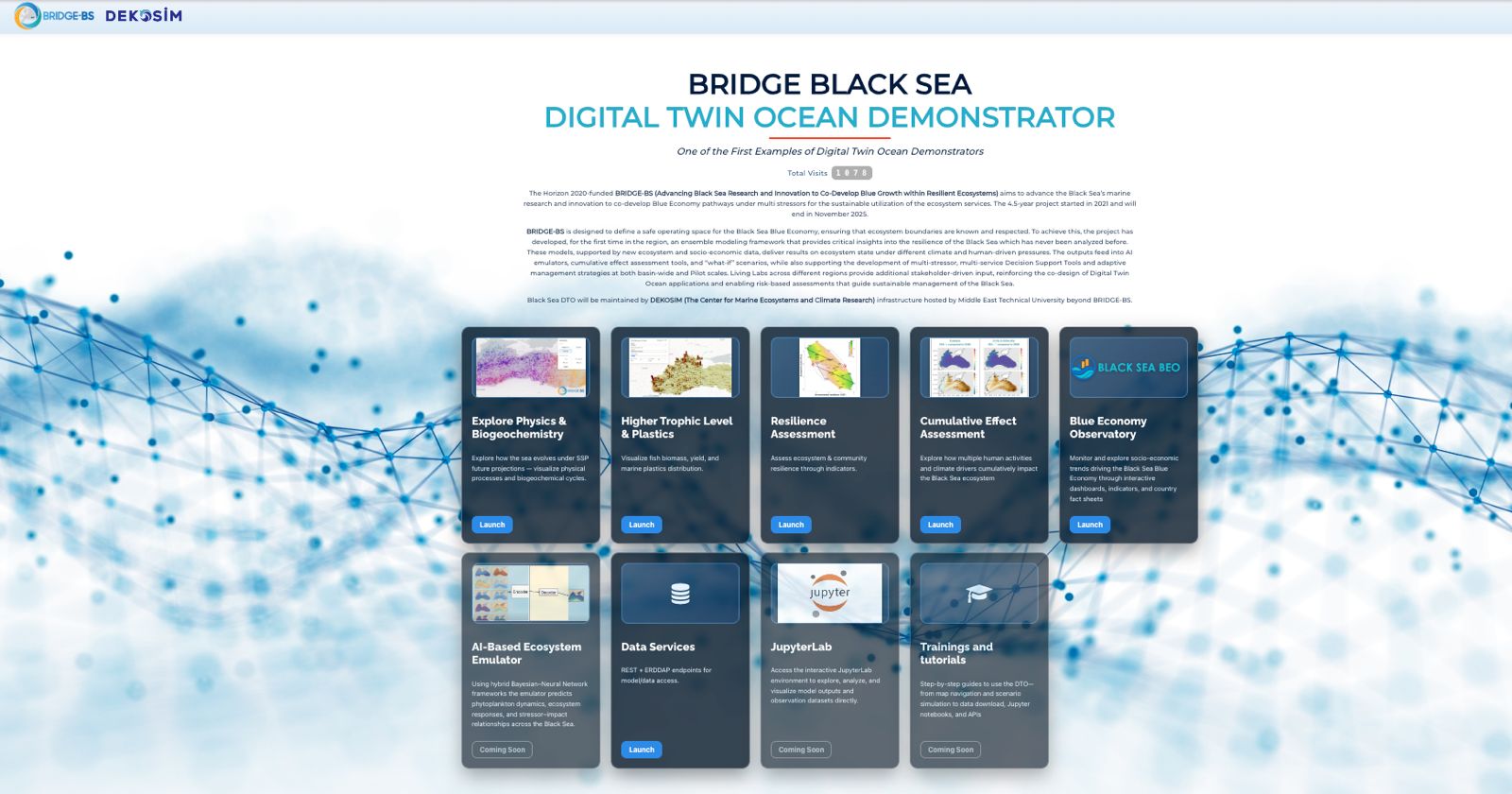
BRIDGE-BS project outputs, with the support DEKOSIM infrastructure, addresses the challenge set by EDITO. The project has developed, for the first time in the region, an ensemble modeling framework that provides critical insights into the resilience of the Black Sea. These models, supported by new ecosystem and socio-economic data, deliver results on ecosystem state under different climate and human-driven pressures. The outputs feed into AI emulators, cumulative effect assessment tools, and “what-if” scenarios, while also supporting the development of multi-stressor, multi-service Decision Support Tools and adaptive management strategies at both basin-wide and Pilot scales. Living Labs across different regions provide additional stakeholder-driven input, reinforcing the co-design of Digital Twin Ocean applications and enabling risk-based assessments that guide sustainable management of the Black Sea.
Addressing target audiences and expressing needs
- To raise awareness and possibly influence policy
- Grants and Subsidies
- Collaboration
The Black Sea Digital Twin Ocean is designed as a policy and decision-support capability linking scientific knowledge, modelling, and data services with governance needs. Our needs focus on engaging policymakers, public authorities, and scientific stakeholders to enable uptake of the DTO in policy development, scenario analysis, and strategic planning at EU, national, and regional levels, ensuring the translation of scientific outputs into operational decision-making and long-term alignment with European and regional marine governance priorities.
- Public or private funding institutions
- EU and Member State Policy-makers
- Academia/ Universities
R&D, Technology and Innovation aspects
The Black Sea Digital Twin Ocean has reached TRL 7, with an integrated prototype demonstrated in an operational environment and validated through policy-relevant use cases. Next steps focus on further operationalisation, improved interoperability with EDITO infrastructures, refinement of user interfaces based on stakeholder feedback, and supporting sustained uptake beyond the project lifetime.
- Europe