
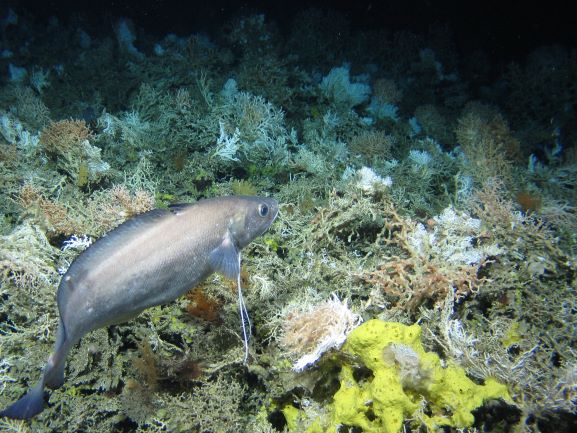
The European Commission, under its Blue Growth Strategy, has been seeking to support sustainable growth in the North Atlantic across five sectors known as Blue Economy: aquaculture, maritime & coastal tourism, blue biotechnology, ocean energy, & seabed mining. However, the balance between societal needs & environmental sustainability required for sustainable Blue Growth poses challenges to economic & policy agendas. We have used the ‘Delphi Approach’ to consider this delicate equilibrium & assess the potential impacts or risks posed by different human activities on deep-sea ecosystem services. The interactive expert-based survey assesses risks to deep sea ecosystem services in the North Atlantic Ocean from climate change, pollution, the blue economy, & their cumulative effects. Our results show pollution & temperature change pose a high risk to more than 28% of deep-sea ecosystem services, while over 19% are at high risk from ocean acidification & fisheries. Services considered to be most at risk of being impacted by anthropogenic activities were biodiversity & habitat as supporting services, biodiversity as a cultural service, & fish & shellfish as provisioning services.
Addressing target audiences and expressing needs
- To raise awareness and possibly influence policy
We want to share our knowledge and by doing so shape and unify future research and policy relating to the Atlantic deep sea.
- EU and Member State Policy-makers
- International Organisations (ex. OECD, FAO, UN, etc.)
- Academia/ Universities
Result submitted to Horizon Results Platform by UNIVERSITETET I TROMSOE – NORGES ARKTISKE UNIVERSITET