Result description
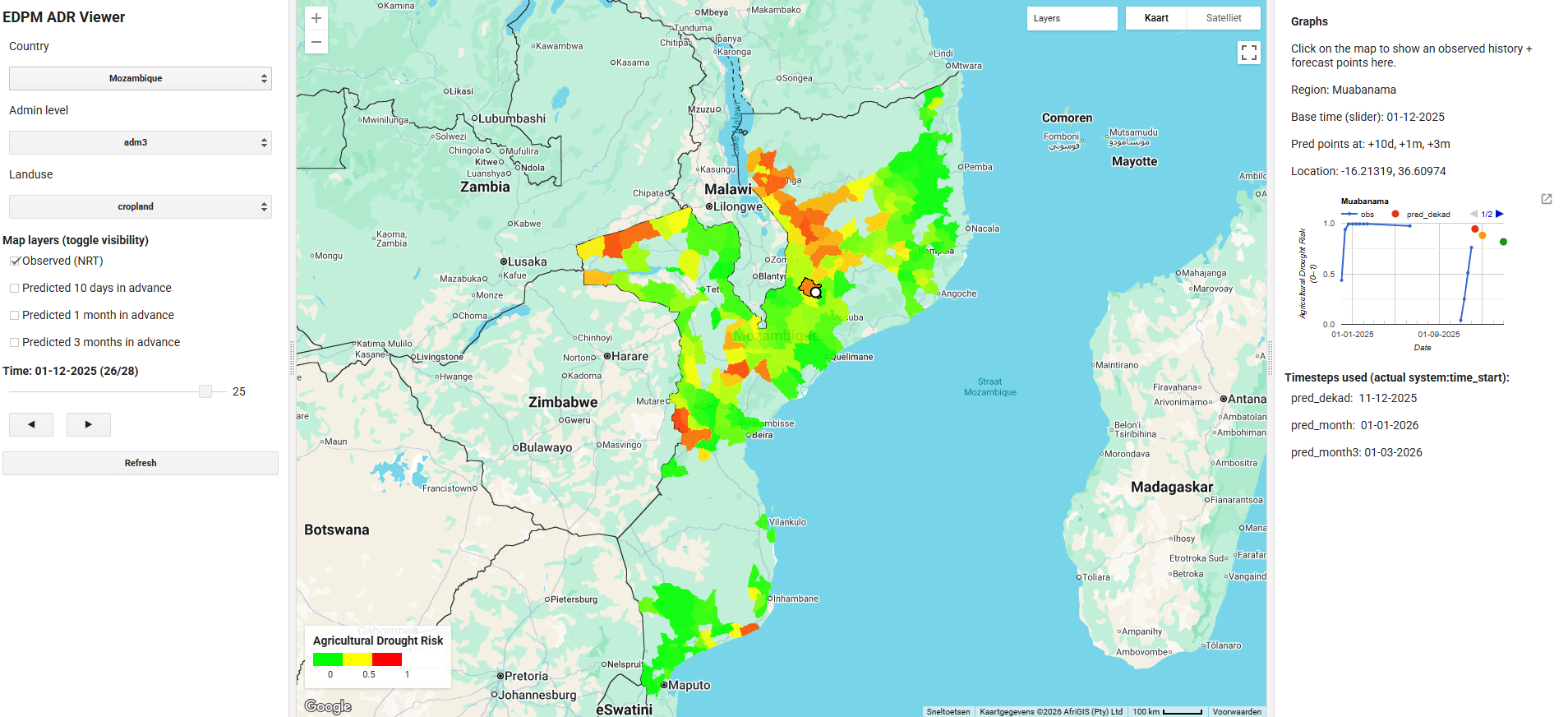
Our result is an early drought prediction model for agriculture to monitor and forecast droughts based on combined Earth Observation data, soil moisture, meteorological forecasts, and environmental baseline data in one operational framework. It delivers analytical projection reports, drought risk zone maps, and 1 km resolution estimates of the expected relative impact of drought on regional crop productivity. The system works at three forecast horizons: 10 days for short-term action, 30 days for seasonal planning, and 90 days for anticipatory preparedness, with updates every 10 days.
Its added value lies in combining multiple indicators, probabilistic risk methods, machine learning, and ensemble-based uncertainty estimates, going beyond near-real-time vegetation monitoring alone. Validated with independent data from Mali, Mozambique, and Somalia, it showed higher predictive skill than NDVI-only approaches. The result can be adapted by existing drought monitoring platforms, public agencies, and service providers to strengthen operational early warning and drought risk management.
Addressing target audiences and expressing needs
- Grants and Subsidies
- Use of research Infrastructure
- Collaboration
Target audience: National meteorological services, regional climate centres, and development/humanitarian organizations implementing early warning and anticipatory action. Secondary: (re-)insurers, risk pools, and agri-risk service providers.
Needs: Partners to pilot, integrate, calibrate, and validate EDPM within existing platforms and workflows, enabling operational use in decision-making and risk financing systems.
- Public or private funding institutions
- International Organisations (ex. OECD, FAO, UN, etc.)
- Research and Technology Organisations
R&D, Technology and Innovation aspects
EDPM is at TRL 6–7, with a validated pre-operational prototype tested in Africa. Next steps focus on MVP hardening, reliability, and pilot deployment with agencies and climate centres. We seek support from public/private funders, investors, and strategic partners to scale productization and commercialization.
EDPM scales through a centralized ML forecasting core and automated EO data pipelines (Sentinel, ECMWF), where incremental clients reuse the same processing, calibration, and validation framework. Country onboarding follows a repeatable ETL workflow (data ingestion -> feature engineering -> model tuning -> validation -> API deployment), limiting marginal costs.
APIs, dashboards, and trigger calculators are standardized, enabling integration into national systems, insurers, and platforms without bespoke builds. Financial projections show cost discipline via controlled FTE growth and automation, while revenues scale through anchors and SaaS. This improves unit economics, with each additional client increasing revenue faster than operational costs while maintaining SLA-driven quality.
EDPM is designed as a sustainable business model by linking economic value creation with measurable societal and environmental impact. It delivers predictive drought-impact intelligence that enables earlier interventions, reducing crop losses, protecting livelihoods, and improving water and land resource management.
Value is created through EO-driven analytics and delivered via scalable APIs, dashboards, and integration into public systems, insurance products, and food-security workflows. Value capture combines anchor-funded public contracts with recurring SaaS revenues, ensuring financial stability and scalability.
Financial projections show a transition from donor-supported deployment to self-sustaining operations with improving margins. By reducing response costs, basis risk, and inefficiencies, EDPM contributes to resilient food systems while maintaining long-term economic viability.
- Africa
- Global
- Europe