
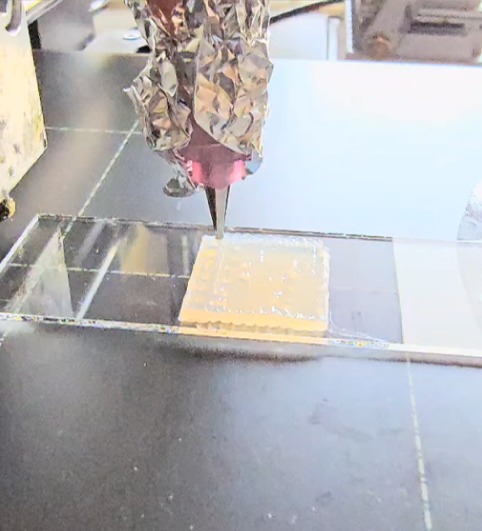
Result description
The result is a modular adaptive 3D printing platform that combines an extrusion systems for low- to high-viscosity materials, hybrid curing modules (UV and thermal), and an integrated particle alignment mechanism within a single configurable architecture. The system includes optimized hardware integration, customizable control software, and tailored G-code strategies to coordinate material deposition, curing sequences, and functional structuring.It enables the fabrication of anisotropic, and functionally graded structures with controlled mechanical, chemical, and thermal properties, supporting applications in biomaterials, composites, ceramics, and smart material systems.
Addressing target audiences and expressing needs
- Collaboration
The target audience includes academic research groups in materials science and bioengineering, university laboratories, biotech and advanced materials startups, and industrial R&D teams in sectors such as biofabrication, soft robotics, ceramics, sensors, and functional composites.
Their precise needs are access to an affordable and flexible 3D printing platform capable of processing low- to high-viscosity materials, integrating multiple curing methods, enabling functional material alignment, and allowing extensive hardware and software customization for advanced research and prototyping.
- Other Actors who can help us fulfil our market potential
- Research and Technology Organisations
- Academia/ Universities
R&D, Technology and Innovation aspects
The system is currently at a laboratory prototype stage (TRL 3),The next step is to further optimize and stabilize the hardware and software architecture, expand validation with a wider range of functional materials and application cases, and improve automation and reliability, with the goal of moving toward pilot-scale testing and higher technology readiness levels
The result is highly replicable thanks to its modular design and reliance on commercially available, off-the-shelf components. The system architecture is based on widely accessible hardware platforms, interchangeable extrusion modules, and standard curing technologies, which can be assembled and adapted by external users without the need for proprietary equipment.