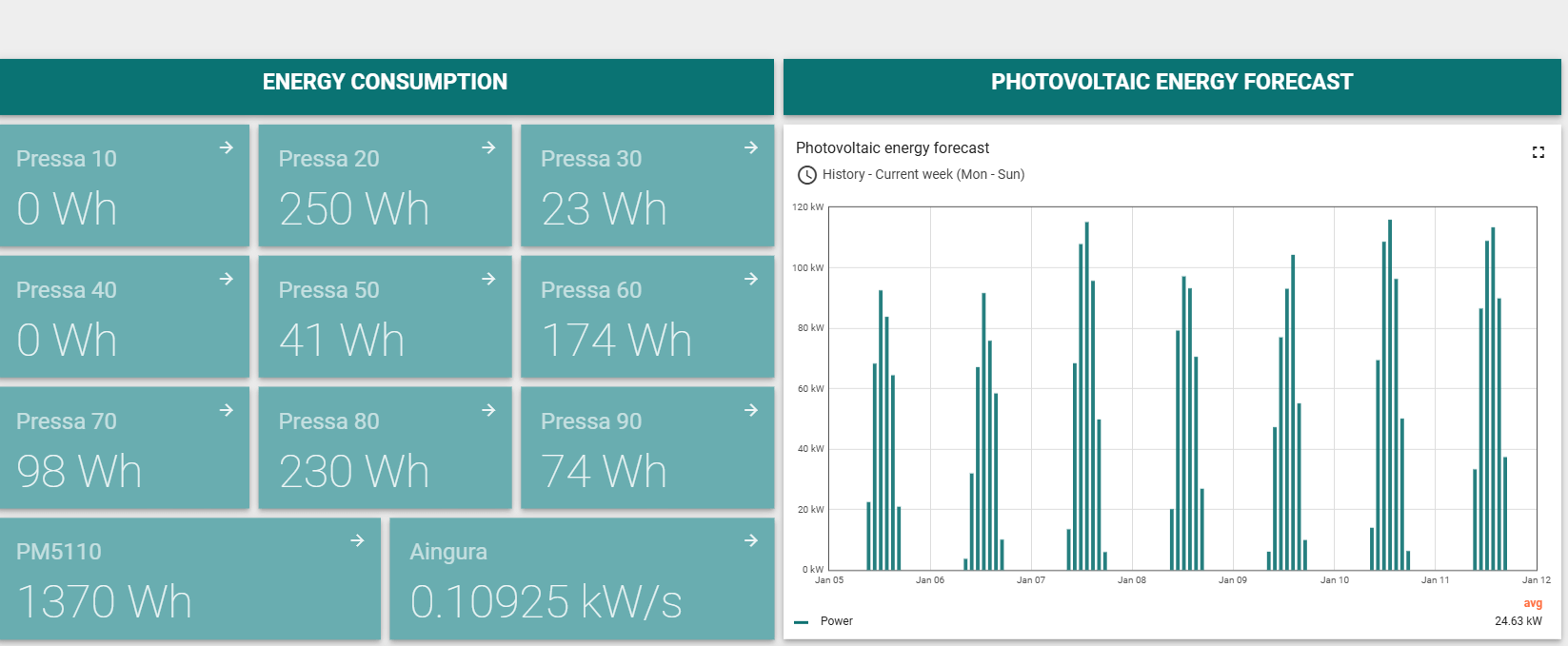
Result description
The SEAC Digital Twin integrates real-time monitoring of energy consumption with forecasting of photovoltaic energy production to support smarter industrial operations. It enables accurate estimation of the energy and time required for each product and aligns production scheduling with renewable energy availability. As a result, manufacturers can reduce energy costs, increase process efficiency, and improve sustainability while maintaining production flexibility.
Addressing target audiences and expressing needs
- Business Angels
- Venture Capital
- Other type of Investment
We are looking for industrial stakeholders interested in adopting Digital Twin solutions for energy-aware manufacturing. In particular, companies with energy-intensive processes and photovoltaic systems willing to pilot tools for optimizing production scheduling based on real-time and forecasted renewable energy availability. This collaboration will support cost reduction, improved efficiency, and a more sustainable industrial operation.
- Private Investors
R&D, Technology and Innovation aspects
Digital Twin has been fully developed in an industrial environment, demonstrating reliable performance in monitoring energy consumption, forecasting photovoltaic production, and supporting energy-aware production scheduling. Next steps include scaling the solution to additional industrial sites, further enhancing real-time optimization capabilities.
The solution is based on a scalable and modular business model that can be adapted to different industrial contexts. The Digital Twin framework can be deployed as a software platform (SaaS) or integrated into existing MES/EMS systems, with scalability ensured through cloud-based services and standardized APIs. The model supports replication across multiple plants and sectors, enabling cost-effective scaling while offering recurring revenue through subscriptions, licensing, and value-added optimization services.
The SEAC Digital Twin solution is highly replicable across different industrial sectors and production sites. Its modular architecture, based on standardized data acquisition (IIoT devices), secure communication protocols, and REST APIs, allows easy integration with heterogeneous machinery, energy meters, and photovoltaic systems. The underlying models for energy consumption and renewable energy forecasting can be re-parameterized with limited effort to reflect different production processes, plant sizes, and energy configurations. This enables rapid deployment in other manufacturing environments, supporting scalable adoption and transferability beyond the original SEAC use case.
The SEAC Digital Twin directly supports sustainability by enabling energy-efficient and energy-aware manufacturing. By aligning production scheduling with real-time and forecasted photovoltaic energy availability, the solution maximizes the use of renewable energy and reduces reliance on grid electricity, leading to lower CO₂ emissions and operational costs. In addition, continuous monitoring of energy consumption and process efficiency allows manufacturers to identify inefficiencies, optimize resource use, and support long-term environmental and economic sustainability, in line with EU decarbonization and energy transition goals.