
Result description
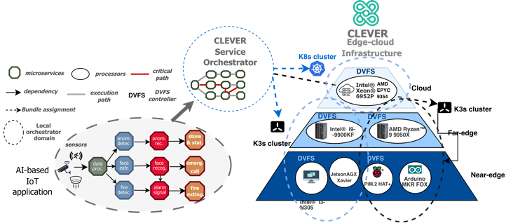
Within the CLEVER project, NTUA developed advanced workload placement and resource allocation algorithms addressing the challenges of limited resources, load balancing, and dynamic configuration across the IoT–edge–cloud continuum. Data-intensive and delay-sensitive applications are decomposed into microservices that submit bids for bundles of compute, storage, networking, and QoS resources to the CLEVER Service Orchestrator (SO), which brokers demand and supply using multi-objective optimization and auction-based mechanisms.
Addressing target audiences and expressing needs
- Collaboration
NTUA’s goal is to further enhance the CLEVER service orchestrator through a novel agentic AI architecture that will empower application developers (users) to interact with AI agents using natural language in order to solve complex multi-objective optimization problems relevant to service and resource orchestration in a distributed edge-cloud continuum. NTUA aims at developing the pre-mentioned novel agentic AI-based framework in order to facilitate exploitation activities after the end of CLEVER project’s lifetime.
- Research and Technology Organisations
- Academia/ Universities
R&D, Technology and Innovation aspects
The concept and problem formulation was available as NTUA’s background knowledge. At the end of the project, proof-of-concept results have been published in prestigious scientific journals (i.e. TRL 3), while lab-scale integration with CLEVER S/W platform has been achieved (i.e. TRL 4). Finally, the CLEVER SO’s functionalities have been integrated and demonstrated as part of CLEVER UCs (TRL 5).