Result description
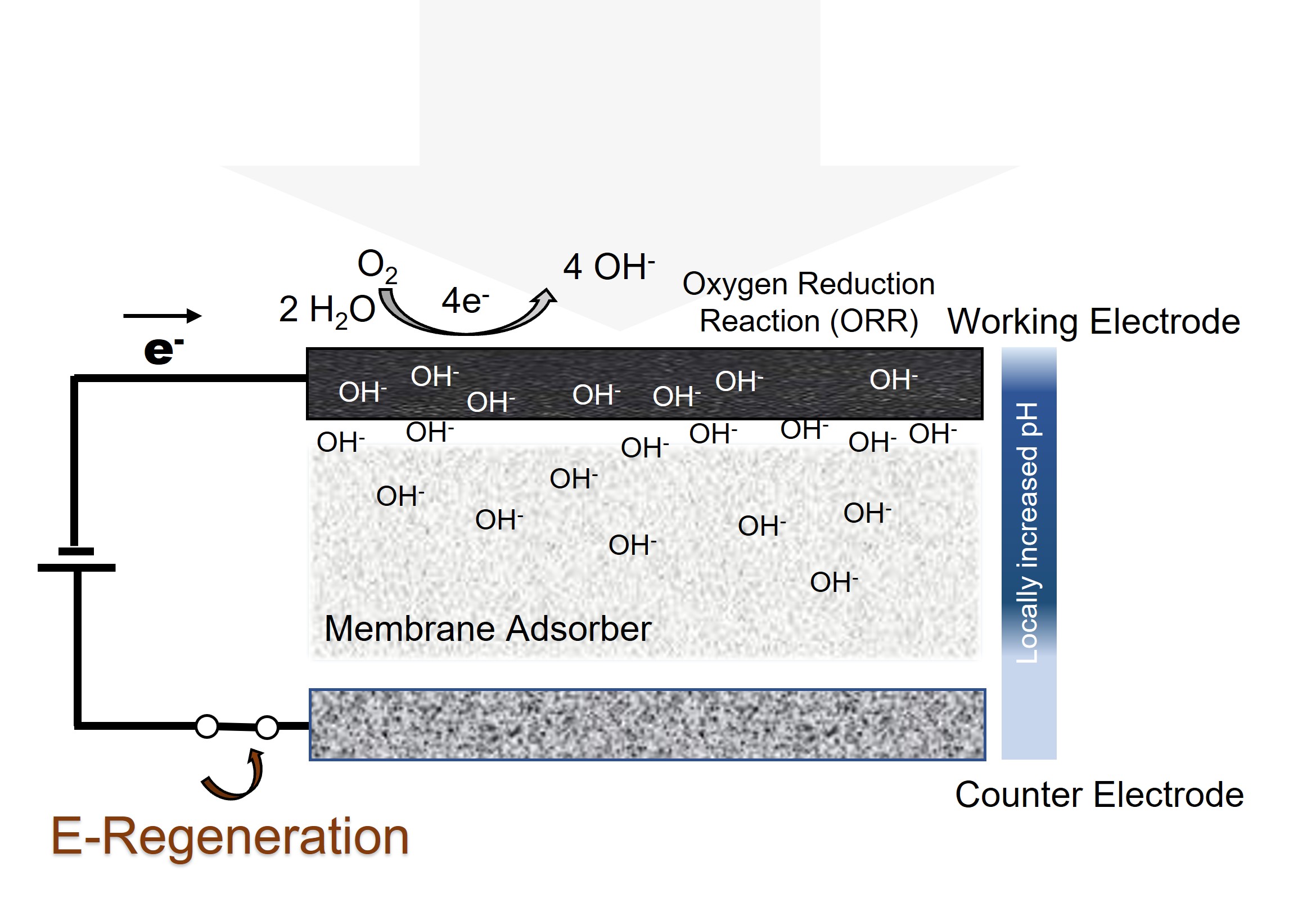
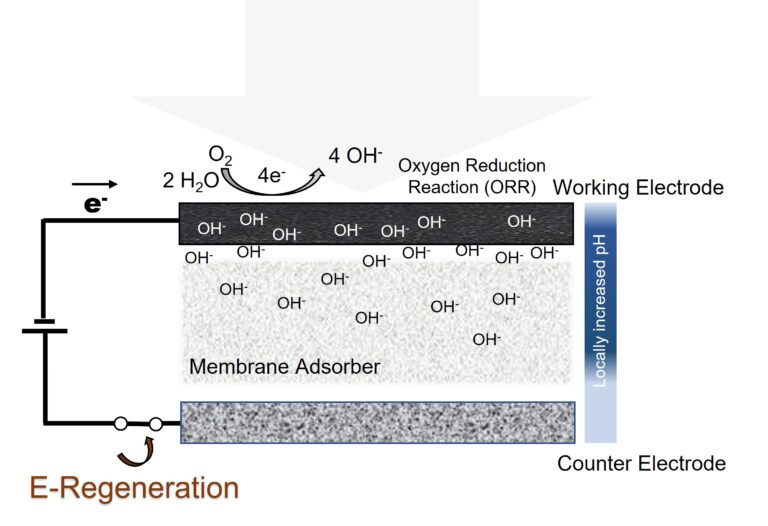
Weak basic anion exchangers (WBAs) exhibit pH-dependent charge behavior: below their isoelectric point (IEP) they are positively charged and effectively adsorb negatively charged natural organic matter (NOM), especially humic substances, which are key precursors of harmful disinfection byproducts (DBPs). This makes WBAs valuable for improving water quality and reducing DBP formation. At alkaline pH, WBAs deprotonate, lose positive charge, and desorb NOM, enabling pH-swing regeneration. We developed a method integrating WBA material into a porous membrane combined with electrochemical regeneration. The thin, porous membrane allows external electrodes nearby, where applying a potential induces oxygen reduction, locally raising pH and triggering WBA deprotonation and NOM desorption. This in situ pH modulation reduces chemical regenerant use. Experimental tests confirmed effective regeneration cycles with consistent NOM removal and efficient pH control due to electrode proximity.
Addressing target audiences and expressing needs
- Collaboration
- a water utility open to do onsite testing with pilot plant
- analytical partner for broader application (PFAS, CECs)
- Research and Technology Organisations
- Academia/ Universities
R&D, Technology and Innovation aspects
The potential-driven regeneration method was tested and confirmed in realistic settings. Multiple membrane adsorbers were evaluated to demonstrate reproducibility across diverse water matrices, including real case study waters and model solutions. Next steps will be upscaling to relevant conditions with optimized operational parameters.