
Result description
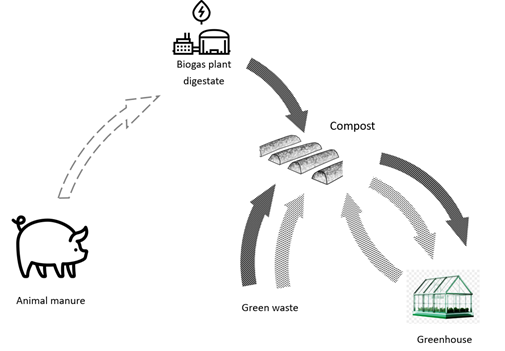
This work presents a circular system that integrates the co-composting of green waste with liquid digestate to reduce nitrogen losses and produce high-quality compost for greenhouse use.
The process involves soaking shredded green waste in digestate, followed by aerobic composting that microbially stabilizes nitrogen in organic form.
The resulting compost is analyzed to determine nutrient availability and optimal application rates, then reused as a soil improver in greenhouse cultivation. This approach supports nutrient recycling, reduces environmental impacts, and enhances the sustainability of greenhouse production systems.
Addressing target audiences and expressing needs
- Help in technical expertise
- Other type of Investment
Composting companies working with green waste and organic residues and companies working with (anaerobic digestion) biogas production
Farmers and greenhouse operators aiming to reduce fertiliser use and to increase circularity of their operation
Policymakers working on circular economy and soil health strategies
- EU and Member State Policy-makers
- Research and Technology Organisations
- Private Investors
R&D, Technology and Innovation aspects
Co-composting green waste with digestate evolved from concept (TRL 2) to system prototype and completion (TRL 6–8), producing stable, nutrient-rich compost while reducing emissions. The technology transitions to CRL 1–2 by assessing market potential, cost structures, and regulatory pathways, while securing funding, building partnerships, and validating its commercial viability.
The technology is highly replicable, as it relies on widely available inputs such as green waste and digestate and established composting principles. Its scalability is supported by modular designs adaptable to different capacities. Standardized parameters such as carbon-to-nitrogen ratios, moisture, aeration, and temperature can be adjusted to local conditions. Required infrastructure, including composting pads, turning equipment, or in-vessel systems, is widely available. Replication depends on climate, regulations, waste systems, and market demand, but with proper guidelines it can be implemented across diverse contexts.
The co-composting of green waste with digestate supports environmental, economic, and social sustainability. It diverts organic waste from landfills, reducing ammonia emissions and contributing to climate change mitigation. The process enables nutrient recycling by returning stabilized organic matter and nitrogen to soils, improving soil structure, fertility, and water retention. Economically, it reduces waste management costs and produces valuable compost that can replace synthetic fertilizers. Socially, it promotes circular economy practices and supports local waste management systems. When properly controlled, emissions and odors are minimized, ensuring environmental compliance.