
Result description
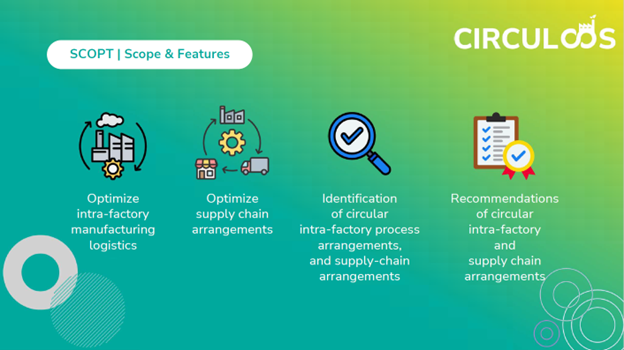
SCOPT models intra-factory logistics and the connections among supply chain actors, offering effective solutions for logistics optimization. It supports production planning, transportation routing, and warehouse management, and addresses challenges such as supply chain stability, inventory, and network design. SCOPT aims to minimize costs, improve delivery speed, and increase efficiency for all participants. Companies can use SCOPT as a verification tool to explore alternative logistics solutions within factories or across the supply chain. The tool optimizes parameters, including CO2 emissions per factory or product, delivery times, and supply chain stability. It also assesses new materials, processes, supply chain participants, and end-of-life strategies such as reuse, remanufacturing, and recycling.
Addressing target audiences and expressing needs
- Business partners – SMEs, Entrepreneurs, Large Corporations
- Expanding to more markets /finding new customers
- Collaboration
We are seeking support from private investors, public funding bodies, and ecosystem enablers to scale, validate, and commercially deploy the optimization tool in real-world settings. Additional funding is needed to enhance the tool by integrating learning-based frameworks for AI-driven applications, improving technical capabilities and interoperability, and exploring new use cases in real environments and supply chains.
- Other Actors who can help us fulfil our market potential
- Research and Technology Organisations
- Academia/ Universities
R&D, Technology and Innovation aspects
The SCOPT tool has reached TRL 6,moving beyond lab validation to successful implementation in industrial pilots.These pilots have reduced energy consumption and increased the use of recycled materials in intra-factory logistics and circular supply chains. We are seeking €1M–€2.5M to expand SCOPT’s presence in the European smart manufacturing market and strengthen our competitive position in the EU
The SCOPT tool is highly scalable due to its modular, model-based architecture and Software-as-a-Service (SaaS) delivery model. It can be deployed across different industrial sectors and supply chain configurations by adapting input data (e.g. processes, resources, constraints) without requiring changes to the core system. Its interoperability with other digital tools and platforms further enables scalable integration within diverse manufacturing environments and multi-actor supply chains.
The SCOPT tool is highly replicable due to its model-based and modular architecture, which relies on standardized data representations (e.g., JSON-based factory and supply chain models) and interoperable platform components. It can be deployed across different industrial sectors and supply chain configurations by adapting input data (e.g., processes, resources, constraints) without requiring structural changes to the core system.
Furthermore, its integration with other platform components (e.g., Digital Twin and LCA tools) enables replication in diverse environments where similar data infrastructures are available.
The SCOPT tool supports long-term sustainability both technically and economically. From a technical perspective, it incorporates AI-driven optimisation to improve resource efficiency, reduce costs, and minimize environmental impact across supply chains. It leverages Life Cycle Assessment (LCA) indicators (e.g., CO₂ emissions) to guide decision-making towards more sustainable configurations.
From a business perspective, its SaaS model ensures continuous updates, adaptability, and low entry barriers for SMEs, supporting long-term adoption and market viability. Additionally, its alignment with circular economy principles enhances its relevance in evolving regulatory and market contexts.
- Europe