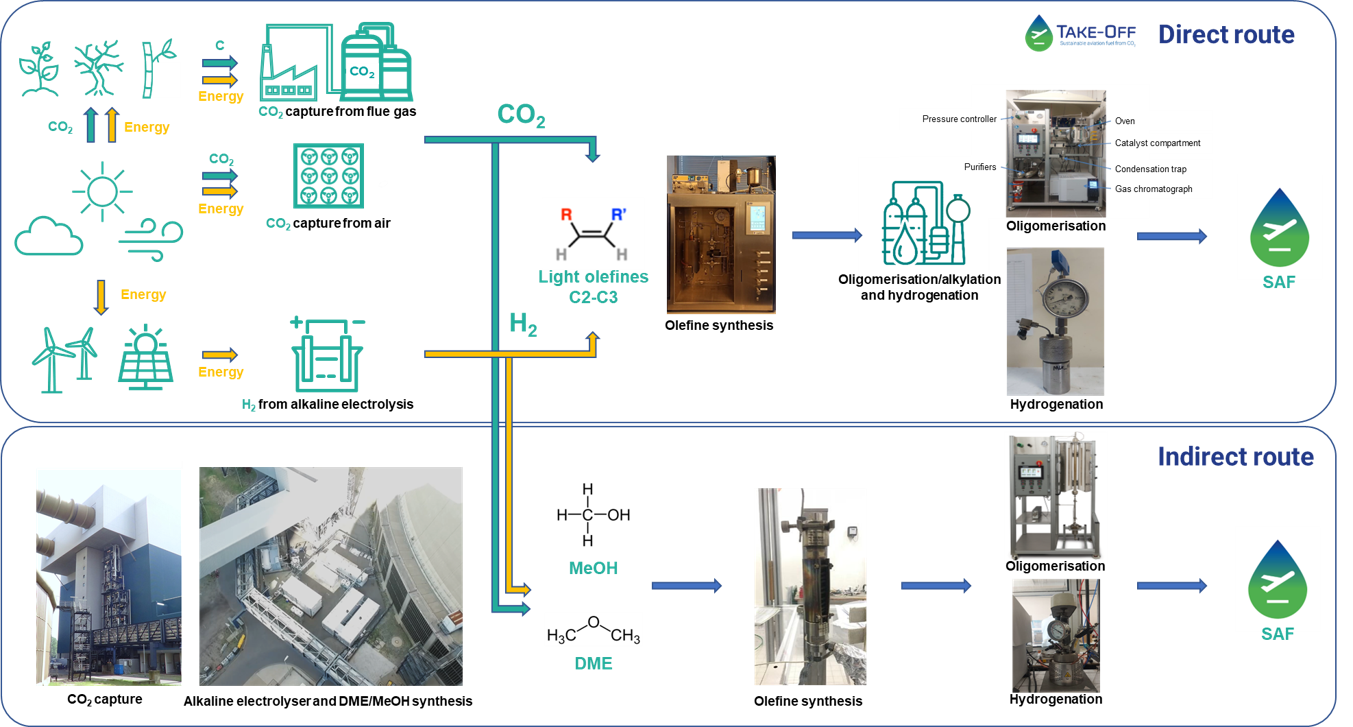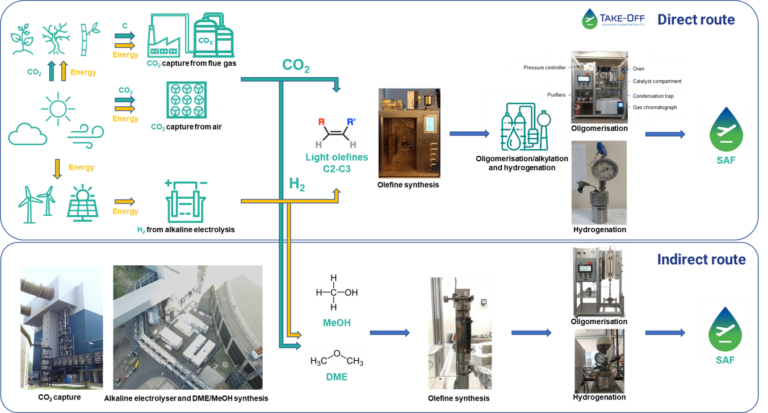
In TAKE-OFF project, the route to convert CO2 and H2 into light olefins was explored. This was done mainly by CNRS with support from TNO, especially in testing the catalyst developed by CNRS at higher scale to identify the degradation of the catalyst. CNRS developed a Series Of Metal Oxide-Zeolite Catalysts for Direct Single Step Light Olefin Synthesis From CO2 And H2. The bifunctional catalyst was tested first at CNRS laboratories and a CO-free light olefins selectivity was reached. Mostly propylene and ethylene have been produced in the olefin mix. Next to this, the methane production was very low, less than 1%. During the tests at TNO (more than 400 hours) no degradation was observed in the catalyst. As the CO is a byproduct in the reaction, it is of great importance to find ways in optimizing the process to accommodate this stream of CO. In Take-off, the CO was recirculated back into the process and tested. This led to the increase of C and Energy efficiency making it competitive with FT route. Next step is to advance the development and to reach TRL5 for the technology and 6 for the catalyst production.
Addressing target audiences and expressing needs
- Grants and Subsidies
- Collaboration
Looking into collaborations to further advance the research and in funding schemes supporting the research. Next to this, we aim to share the learnings within the scientific community.
- Public or private funding institutions
- Research and Technology Organisations
- Academia/ Universities
R&D, Technology and Innovation aspects
The aim of the TAKE-OFF project was to advance the technology from Technology Readiness Level (TRL) 3 to 4. Next step is to mature the technology to TRL5-6.