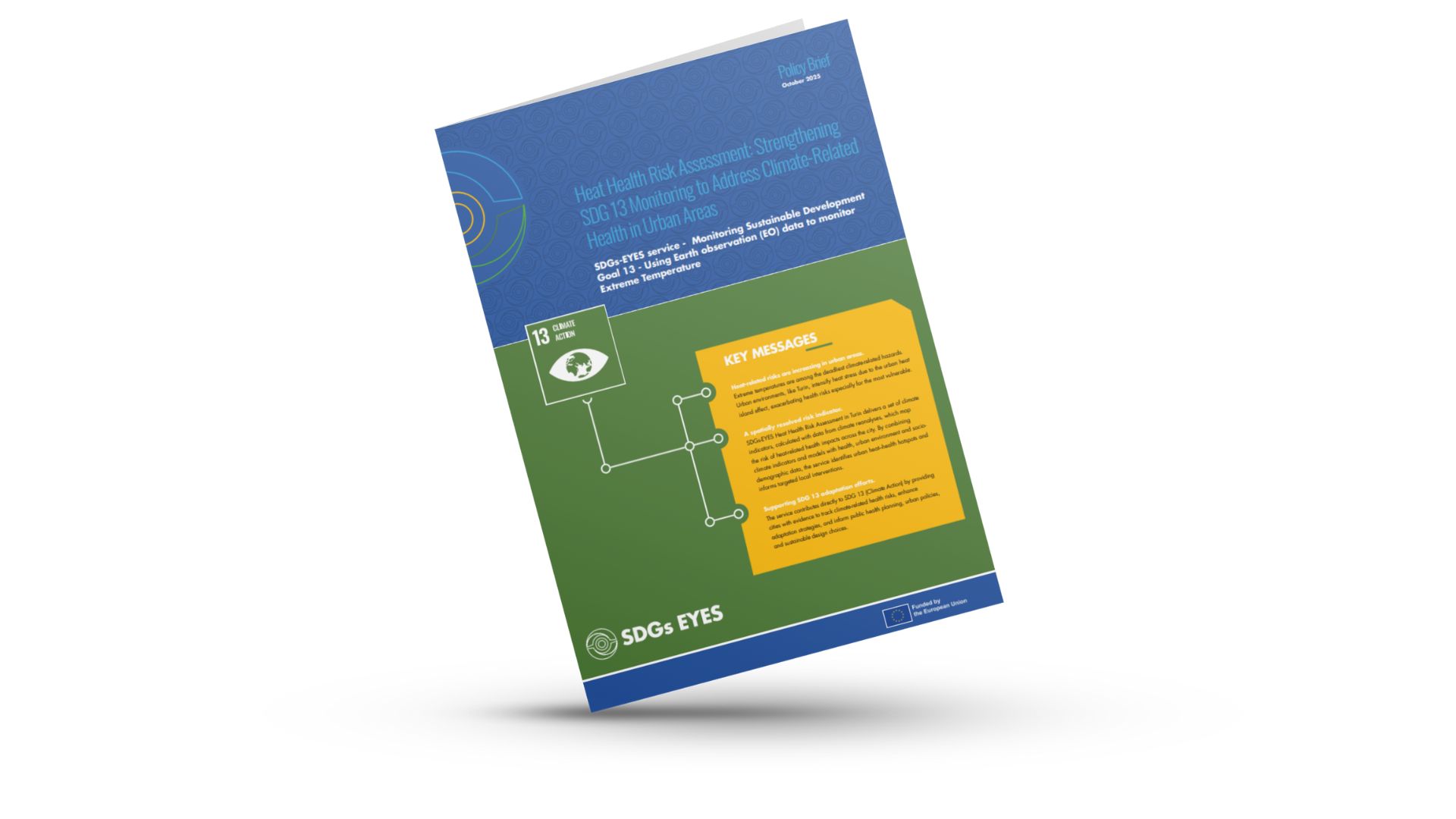
SDGs-EYES Heat Health Risk Assessment is a co-designed service that maps the spatial distribution of heat-related health risks in the city of Turin. By integrating Copernicus climate reanalysis data, health data, urban context and census-derived sociodemographic indicators, it produces a risk indicator that reflects climate hazard, exposure and vulnerability. The service identifies urban areas where heat stress coincides with the presence of at-risk populations. These include elderly residents, people with limited mobility or poor housing conditions, and neighborhoods with low adaptive capacity. The result is a map-based tool that highlights where heat-health risk is highest and identifies its main determinants – at the level of individual urban census tracts – and consequently supports policy decisions such as prioritising cooling interventions or issuing heat warnings.
Addressing target audiences and expressing needs
- To raise awareness and possibly influence policy
SDG Target 13.1 “Strengthen resilience and adaptive capacity to climate-related hazards and natural disasters in all countries” calls for strengthening resilience and adaptive capacity to climate-related hazards, including heatwaves. Addressing this challenge requires tools that combine climate data, urban characteristics and population vulnerability. SDGs-EYES Heat Health Risk Assessment in Turin demonstrates how such integration can support evidence-based policymaking for urban health adaptation.
- Public or private funding institutions
- EU and Member State Policy-makers
- International Organisations (ex. OECD, FAO, UN, etc.)
Result submitted to Horizon Results Platform by AZIENDA SANITARIA LOCALE TO3