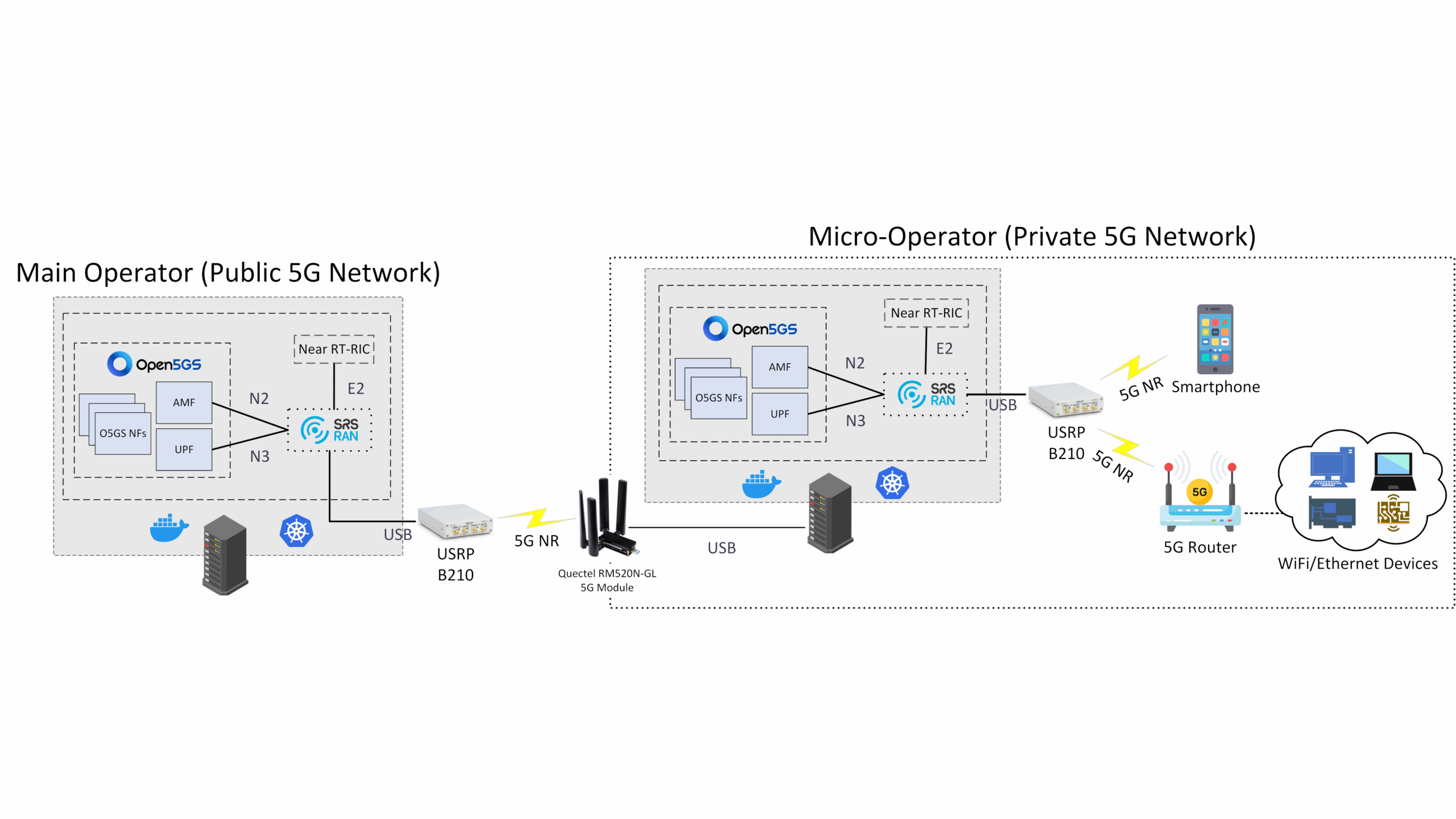
The Micro-Operator paradigm enables organizations to deploy small-scale 5G base stations to serve the particular needs of their consumers, while also serving as neutral hosts for large-scale operators.
The Micro-Operator paradigm was investigated in a laboratory environment, using Software Defined Radio (SDR) devices and open-source software to deploy an Open-RAN-compliant 5G base station. Specifically, the srsRAN software is used to manage the SDR devices, while the Open5GS software provides core network functionalities.
In the context of the NANCY project, two scenarios were investigated, namely a cyberattack detection scenario and an inter-operator service exchange scenario. To run these scenarios, a laboratory testbed was deployed which consists of two 5G networks, respectively for the Micro-Operator and the public operator. Of note, the Micro-Operator and the public operator are connected through a 5G connection.
Addressing target audiences and expressing needs
- Collaboration
We are looking for collaborations with researchers, technology developers, and network operators to build next-generation communications infrastructure using open source protocols and technologies (e.g., Open-RAN, Software Defined Networks, Software Defined Radio, etc.)
- Research and Technology Organisations
- Academia/ Universities
R&D, Technology and Innovation aspects
Currently, the Micro-Operator has been demonstrated and validated in a controlled laboratory environment. The next steps focus on scaling up the infrastructure to provide service to multiple users and validate its efficiency in demanding application domains.
The Micro-Operator paradigm has been deployed in a laboratory environment, while a cyberattack detection scenario was investigated. Three project deliverables, namely D6.4 In-lab testbeds definition, D6.5 Greek in-lab testbed dataset 1, and D6.7 Greek in-lab testbed dataset 2, document the hardware and software for the Micro-Operator deployment.