Result description
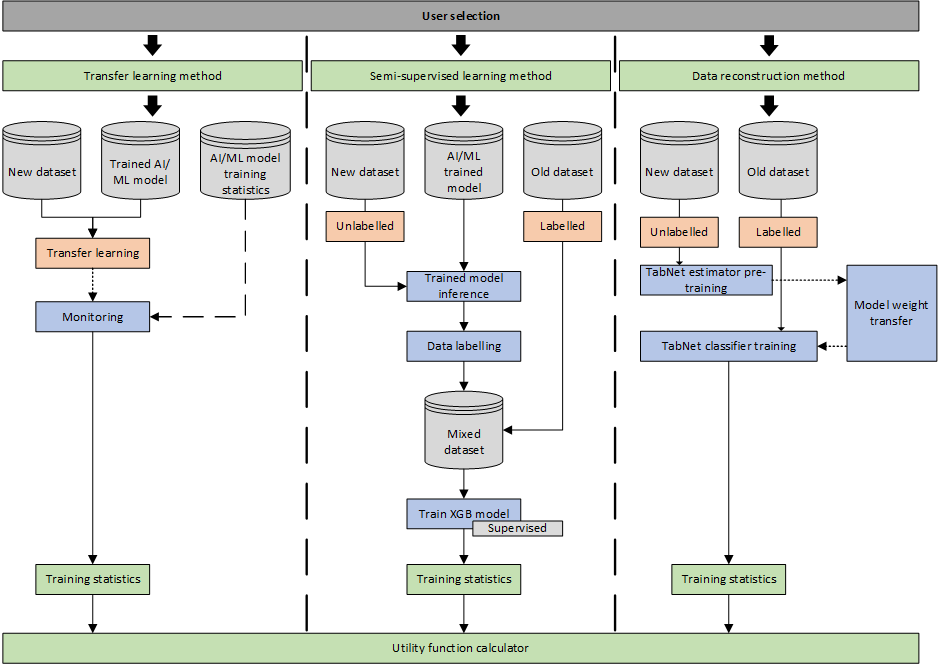
Main features: End-to-end machine learning pipeline, data processing components, machine learning algorithms.
Objectives: To increase the efficiency of ML models, to achieve near-optimal performance in data/concept drift detection tasks, in next generation 6G networks, to reduce energy consumption during the model retraining operations.
What is new: Existing methodologies consider only a few factors to assess whether an AI model be retrained or not, given new input data. NANCY’s data drift and concept drift detectors employ a complex yet highly computational efficient mechanism to integrate several parameters into the mix. This highly increases the assessment accuracy and perfectly situates the result under investigation to be used in production environments.
Why is it important: This exploitable result does not only advance the state-of-the-art of the AI models for data drift and concept drift detection, but also it provides a real solution for next generation 5G/6G networks. The algorithms are designed to achieve near-optimal performance in real-world scenarios with real-world data.”
Addressing target audiences and expressing needs
- To raise awareness and possibly influence policy
New investment and collaboration opportunities to advance the TRL of the solution to 9.
- EU and Member State Policy-makers
- Research and Technology Organisations
- Academia/ Universities
R&D, Technology and Innovation aspects
We are looking for: (i) private investors to scale the TRL of the solution to 8/9; (ii) External collaborators to help us realise a concrete market analysis and a robust business plan; (iii) Partnerships with academic institutions or SMEs to add more features to the solution.
Within the NANCY project, we have prepared 2 publications on high impact IEEE journals that describe the basis, applicability and replicabilityof the result. Both of those papers are current under publication. Also, the results is tested using real-world data, which were collected within the project’s lifetime.
The core focus of this result is to automate and optimise management decisions for large-scale AI model deployment scenarios. One of the key aspects of the result is the reduced energy consumption of the system, which leads to economic and environmental benefits. This result is the backbone of a sustainable AI model management scheme which we consider of high importance nowadays, especially given the fact that contemporary AI models consume a significant amount of energy for their training and re-training operations.