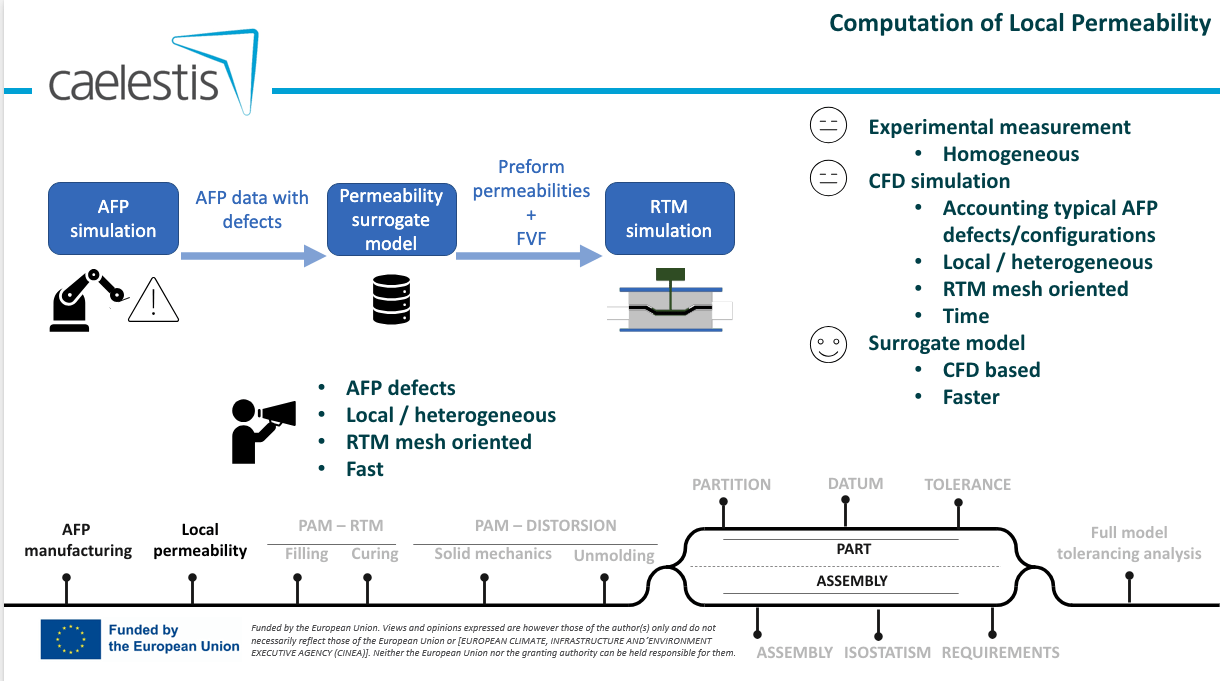

Automated Fiber Placement (AFP) is highly efficient but introduces manufacturing defects (gaps, overlaps) that alter the permeability of composite preforms. Standard simulation tools often assume “perfect” preforms, failing to predict how these upstream defects impact the subsequent Resin Transfer Molding (RTM) injection phase. This leads to unforeseen dry spots, voids, and high scrap rates in complex aerospace parts.
We have developed a novel surrogate model (TRL 4) that bridges the gap between AFP and RTM simulations. By integrating physical simulation data, the model predicts how specific AFP defects influence resin filling behavior and flow fronts. Written in Python, it serves as a “computational bridge,” allowing manufacturers to anticipate and mitigate impregnation issues before physical production begins.