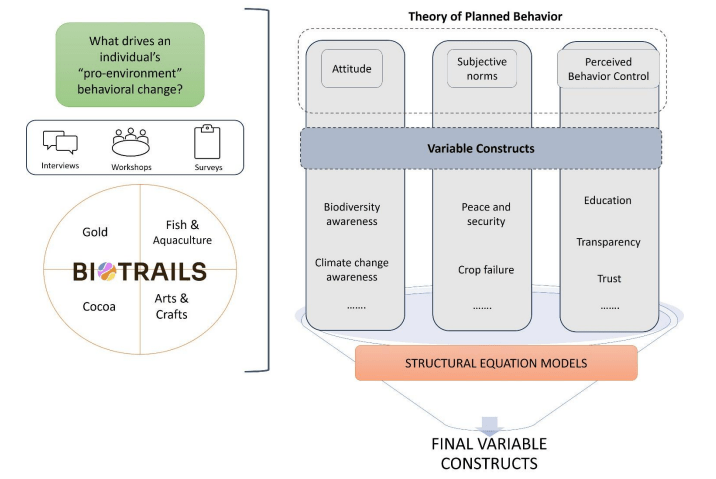
The method developed uses the personal norms and behavioral patterns of value chain members, and uses them to detect leverage points that need to be transformed. It does this within each step of the value chain and allows to detect which parts of the value chain are perceived by its members as more influential on biodiversity. This will then allow to detect which are more likely and which are more needed to change.
Addressing target audiences and expressing needs
- We are sharing our knowledge
new collaborations – explore the potential for new research project (application to public funded research programmes)
- Others/ No specific audience
R&D, Technology and Innovation aspects
The Structural Equation Model has been developed and applied on the fisheries and aquaculture sectors. The next step is capitalizing on it to respond to the needs and priorities identified during the analysis. That involves developing training schemes for sectoral employees. Part of the method is embedded in new project proposals that could capitalize on the approach.
The result replicability is possible, but under requirements. It required data collection which was the most resource demanding task, as data is collected through interviews, surveys and focus group discussions. If these are carried out, replicability is possible as all coding of the result is made publicly available.