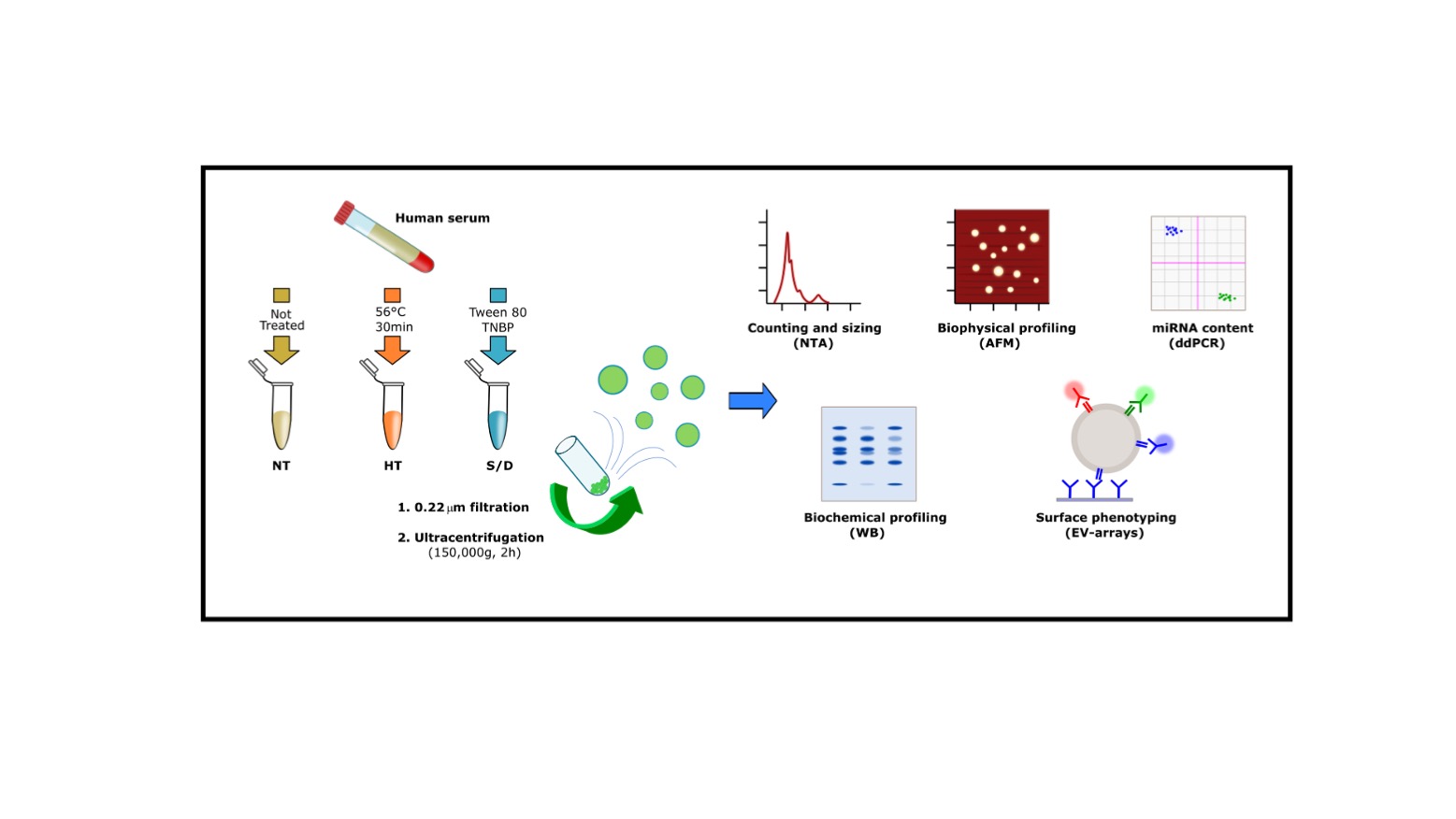
Since the outbreak of COVID-19 crisis, the handling of biological samples from confirmed or suspected SARS-CoV-2 positive individuals demanded the use of inactivation protocols to ensure laboratory operators safety. While not standardized, these practices can be roughly divided in two categories, namely heat inactivation and solvent-detergent treatments. Assessing the impact of virus inactivating pre-treatments is of pivotal importance, given the well-known variability introduced by different pre-analytical steps on downstream EVs isolation and analysis.
Our data suggest an increase in ultracentrifugation (UC) recovery following heat treatment; however, it is accompanied by a marked enrichment in EVs-associated contaminants. On the other hand, solvent/detergent treatment is promising for small EVs (<150 nm range), yet a depletion of larger vesicular entities was detected. This work represents a first step towards the identification of optimal serum inactivation protocols targeted to EVs analysis.
Addressing target audiences and expressing needs
- Use of research Infrastructure
Transmission Electron Microscopy analysis
- Research and Technology Organisations
- Academia/ Universities
R&D, Technology and Innovation aspects
Far from being conclusive, our data suggest that the use of solvent/detergent addition could be seen as a preferable virus-deactivating method, taking EV’s purity obtained after a single UC step into account and as far as small EVs isolation and analysis are concerned. Non-ionic detergents are indeed relatively mild and usually non-denaturing [ 16 ], but they are known to break lipid–lipid and lipid–protein interactions. This could account for the apparent higher purity of EVs obtained after S/D treatment (see WB analysis), which contrasts with the higher content of lipoparticle contaminants detected following heat treatment. In this sense, their use of upfront UC cycles could be worth further investigating. On the other hand, solvent/detergent treatment led to the depletion of vesicular particles of larger size (>150 nm), and their use should be cautiously pondered if this EVs subpopulation represents the target of analysis. In contrast, heat-based protocols provided higher recovery, and the enrichment in EVs contaminants could be counterbalanced by the introduction of a subsequent step of purification. Overall, the virus-inactivation procedure should be tailored considering the downstream analysis to be undertaken, and further work will be needed in this direction to identify the best possible practices.