
Result description
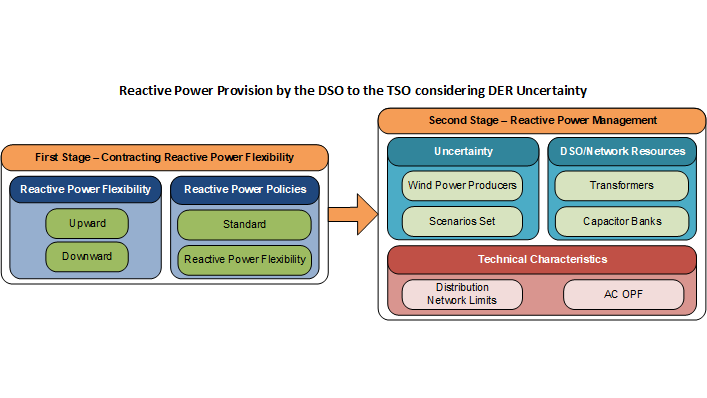
The tool uses a two-stage stochastic AC-OPF to determine the reactive power flexibility that must be contracted by the DSO from the DERs, ensuring that the service provided to the TSO is met, as well as the operation of the distribution network. This flexibility is contracted in advance (day-ahead) to deal with any congestions and voltage problems that may occur during operation. With this tool, the DSO is able to negotiate flexibility with any DER in the distribution network to mitigate congestion and voltage problems in the network, as well as in the TSO/DSO interconnection. Thus, the tool is capable of:
- Supporting the DSO to provide a reactive power service to the TSO. In this particular, the tool optimizes the amount of flexibility and equipment levers that need to be taken to partially/fully meet the TSO request;
- Assessing the risk of each operating scenario, reserving the necessary flexibility to face uncertain RES production;
- Offering operational suggestions to meet the minimum voltage deviation requirements in the network, in addition to improving the voltage profiles throughout the day.
Addressing target audiences and expressing needs
- Grants and Subsidies
We have a proof of concept tool and we are looking for distribution system operators (DSOs) interested in proof of concept activities. Main advantages of the tool are:
– Perform day-ahead reactive power management. This tool is able to express the needs of DERs flexibility that the distribution network may need during operation. It is able to determine the flexibility the DSO has to contract in advance of the operating hour:
– Minimize the costs of contracted flexibility and the number of changes in static equipment (e.g., transformers with OLTC and capacitor banks);
– Address RES uncertainty connected at the distribution network through the stochastic AC-OPF;
– Determines whether there is sufficient flexibility at the distribution network to meet TSO requests at the TSO/DSO connection. It is able to schedule the maximum available flexibility from DER trying to meet the TSO request or limited by a certain cost for flexibility established by the TSO (i.e, the maximum the TSO is willing to pay for the service).
- Public or private funding institutions
R&D, Technology and Innovation aspects
This technology has already been tested and proved successful based on real-world cases:
• A case study of a 37-bus distribution network with 10 distributed energy producers;
• A real French distribution network (data provided by EDF) with two wind turbines as energy resources. The tool’s results were validated by EDF through a software used in the operation of the distribution network. It was verified that the developed tool complied with the requirements imposed by EDF.
• Two real distribution networks provided by E-REDES. Distribution networks include several energy resources, including wind turbines, in which it was found that the tool developed allows for an improvement and stability of voltage levels in the distribution networks. It was validated that the network operating suggestions made available by the tool not only meet the minimum voltage deviation requirements in the network, but also improve the stability of voltage levels throughout the operating day.
For better performance, the tool is suitable for problems with up to 10 uncertainty scenarios per renewable generator. Replicability is possible when applying the same reactive power policies applied in this tool. Nevertheless, the tool requires to be adapted to each of the distribution network characteristics of the DSO, as usually different rules can be applied within the same DSO.
This tool was designed with the aim of supporting and improving the DSO network operation, ultimately improving the power quality for consumers. In fact, improved reactive power management in the distribution network, using DER capabilities, results in fewer voltage problems and, consequently, better power quality for end-users. In addition, this tool designs and offers a reactive power service for the TSO. This service is provided by the DSO through adjustments at DERs operating point, which can be negotiated between the DSO and the DER agent. This service allows the TSO to reduce reactive power flow in the transmission network, leading to less congested power lines and more energy efficiency use. In short, this tool is able to help improve energy efficiency from DER location to the DSO/TSO connection, contributing to a more sustainable energy deliver system.
- Global
- Europe